
Strength training at home can feel deceptively simple, but strangely overwhelming at the same time. On the one hand, it seems pretty simple and straightforward - you don’t need to go to the gym, aren’t required to have fancy equipment, and don’t need a lot of space. Yet, despite knowing this, many women still struggle with getting started with strength training from home in a way that’s doable and produces results.
For women in midlife, the hesitation makes sense. Not too many of us grew up learning how to lift weights or seeing other women in our lives strength training. We were taught cardio, high-intensity classes, how to follow along, burn calories, and keep moving to burn as many calories as possible.
But strength training asks something different of us. It asks us to practice patience, repetition, and to trust that the small, consistent work you put in will add up. We’re also bumping up against some pretty serious fears, doubts, and misconceptions about the results that strength training will produce (like getting too bulky).
But this article isn’t about addressing fears; it’s about helping you understand what actually matters when you start an at-home strength training journey and what it actually takes to see results.
What “Strength Training at Home” Really Means
Strength training doesn’t require a gym membership, a full gym setup, or complicated routines. At its core, strength training means challenging your muscles with resistance so they have a reason to adapt, change, and grow. When choosing to strength train from home, that resistance typically comes in the form of dumbbells, bands, and your own bodyweight.
The most important aspects of your home training program have nothing to do with where you train, but rather that the movements are intentional, repeatable, and progressively challenging over time.
You Don’t Need Much Equipment to Start
One of the biggest misconceptions is that you need a lot of gear before you begin. And, honestly, this is what keeps many women stuck in place instead of getting started. The reality is, all you need to get started is:
- A couple of sets of dumbbells (a lighter and a heavier set)
- A small space to move
- Comfortable clothes and supportive shoes
That’s really it. If you’re unsure what weights to choose to start with, that’s normal. Most women prefer to start with lighter weights and work their way up. This is also the safest way to begin lifing. I recommend grabbing a set of 5 lb dumbbells and 10 lb dumbbells to begin with.
Start With a Few Foundational Movements
When you’re new to strength training, it’s best to start with the basics and to understand that more exercises aren’t better. Focusing on a small number of foundational movements will allow your body to learn the basic patterns that will carry over into everything else. Strength training basics include squats, hinges, presses, rows, and carries, and these are the movement patterns that will show up in your daily life, which is why they are so important to focus on.
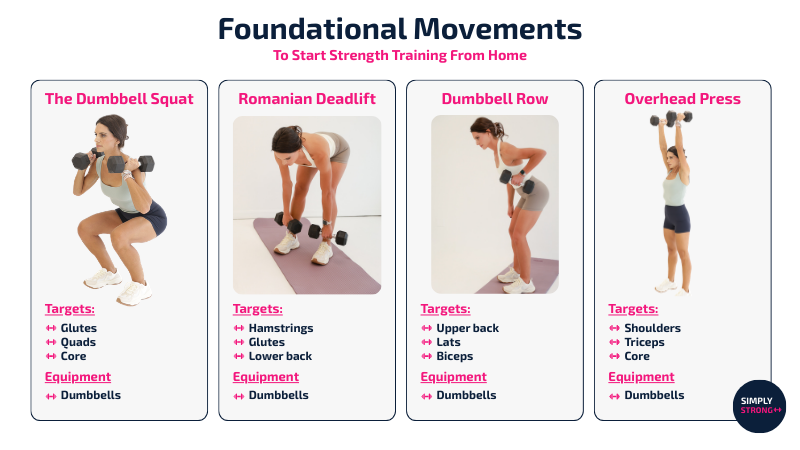
Repeating the most basic strength exercises is how you begin to develop strength, coordination, and confidence in your home training journey.
How Often You Should Strength Train at Home
As a beginner, more isn’t better. For most women, two to four strength training sessions per week is plenty. This training volume gives your muscles time to recover and adapt while still creating consistency.
On the days when you’re not strength training, supplementing your sessions with walking, mobility work, stretching, or other gentle movement will support your recovery and allow you to make the most out of your strength sessions.
Why Following Along Isn’t the Same as Learning Strength Training
Follow-along workouts (like Beachbody and FasterWay to Fat Loss) can be helpful for getting you moving and building an exercise habit, but they can also prevent you from realizing your full potential.
If you’re constantly changing workouts or never tracking what weights you use, it’s really hard to know whether you’re actually getting stronger and making progress. Strength training and progressive overload work best when you know what you’re practicing and why.
An effective strength training program done from home encourages you to pay attention to your form, your exertion, your weight selection, and your rest times. This is very hard to accomplish with follow-along workouts.
What Your First Month Usually Feels Like
The first couple of weeks of strength training can feel a little awkward and will require that you commit to trusting the process. Some of the movements might feel unfamiliar, and you might feel soreness in new places. You also might wonder if you’re doing everything “right” because no one is there to guide you personally. All of this is very normal and to be expected.
Strength doesn’t magically appear after a single workout or even within a couple of weeks, but you will start to notice some progress pretty quickly. Within your first month of strength training, women often experience better balance, improved coordination, and growing confidence with exercise execution. Dramatic physical changes will take more time, but the evidence of positive changes, especially for the aging female body, will begin to present quickly.
The Role of Warm-Ups and Rest
Warm-ups and rest play just as important a role as the exercises themselves do, especially for women over 35. A good warm-up helps your joints move well, gets your blood flowing, and primes and prepares your body for the main exercises. At home, this can be short and simple - it’s not about exhausting yourself before the workout starts, it’s about making sure your body is ready for the load so it can support you with less risk of injury.
In addition to proper warm-ups, resting between sets is vital as well. Unlike group fitness classes or follow-along workouts, where you’re quickly transitioning from one exercise to another, strength training demands that you stop and rest between sets. It’s not rushed. When you give yourself ample time between sets, you’re able to pick up appropriate weights that challenge your body and maintain good form throughout the exercise.
How to Know You’re Doing Enough
This is honestly one of the most common questions women have when it comes to starting a basic strength training program from home. This is especially true for women whose prior workout experience involved high-calorie burns and feeling absolutely gassed after their workouts.
A good, effective strength training session should leave you feeling worked, but not wrecked. You should feel like you challenged yourself without completely draining your energy for the rest of the day. You should care a lot less about the arbitrary number of calories burned on your fitness tracker and a lot more about your intentionality with each exercise and weight selection. This is how muscle is built, and muscle is your metabolism. The more muscle you have on your frame, the more calories your body burns at rest, making strength training the most efficient way to burn calories long term.
Starting Simple Is How You Stay Consistent
If you’re about to start on a strength training journey at home, congratulations on taking the first step toward a healthier, fitter, and more capable person. Keep in mind that the goal isn’t to do everything at once; it’s to build a foundation that feels sustainable and doable.
Simply workouts, repeated regularly, are what create real progress that will last. If you’ve ever felt confused or intimidated by strength training at home, rest assured that, with the right plan, it’s one of the simplest and most effective ways to build real strength and a body you’re proud of. You can move at your own pace, learn your body, and build confidence without any pressure.
Strength training isn’t as complicated as it has been made out to be. Start from where you’re at with what you have and give yourself permission to grow from there.