
One of the biggest barriers to starting strength training at home is the assumption that many women hold that they need to have a full gym setup to get started. Thankfully, you don’t.
For women over 35, especially in midlife and perimenopause, effective strength training is less about having more equipment and more about using the right tools (the basics) consistently and progressively.
One of the biggest barriers to starting strength training at home is the assumption that you need a full gym setup.
You don’t.
And that’s amazing news because you can build meaningful strength, support muscle retention, improve bone density, and train to age more gracefully with a very small amount of equipment.
Equipment for Home Strength Training
Start With Dumbbells
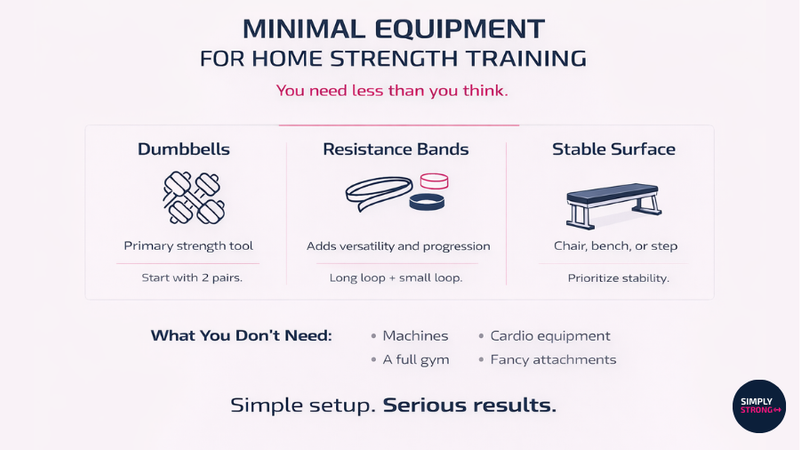
If you could only invest in one thing to get started on your strength training journey, make it dumbbells. Dumbbells allow you to train all your major muscle groups and movement patterns (squats, hinges, presses, rows, lunges, and carries) all from home. They’re versatile, space-efficient, and scalable as you get stronger and need to make increases.
Ideally, you’ll want to start with at least two sets of dumbbells - a lighter pair and a heavier pair. Many women in midlife find that they can use heavier weights for many lower-body exercises but require lighter weights for upper-body strength exercises. This is very normal and to be expected, which is why it’s helpful to have a couple of pairs to start out with.
As you progress in your strength training journey, you’ll inevitably need to invest in some heavier and more diverse weights. One of the most budget-friendly ways to do this is to invest in adjustable dumbbells. But you can also slowly build out your standard dumbbell selection as well. There’s no right or wrong way to go about it; it’s a decision that’s made based on your budget and space availability (adjustable dumbbells save a lot of space).
Resistance Bands Add Variety and Versatility
There are two types of resistance bands that I recommend to women working out at home: long loop bands (to replicate cable machines and pulling exercises) and small loop or “booty bands” for glute activation and extra tension.
Bands are an inexpensive and space-efficient way to add variety and versatility to your workout setup. There are many different exercises that can be performed with a band, and although the resistance is lighter than that of dumbbells, the effect can be just as powerful.
Bands also help you to add additional resistance and intensity when you max out your at-home weight selection and need to keep progress going.
A Stable Surface
Contrary to popular belief, you don’t need a full fitness bench to get started with strength training from home. A study chair, ottoman, or step can work just as well for exercises like:
- Split squats
- Hip thrusts
- Elevated push-ups
- Step-ups
The most important thing to prioritize is stability. Ensuring you’re able to perform these exercises safely is key. If your surface wobbles or is not approved to hold your weight, don’t use it. If you have the budget (and space) for a small bench, I recommend getting an incline bench so that you can utilize even more exercise variations.
A Mat (Optional, But Helpful)
There will be some at-home strength training exercises that you will perform from the floor, like core work, stretching, and mobility exercises - having a simple mat or designated surface will make performing these exercises more comfortable.
A mat is not required for most strength-specific exercises, but it’s nice to have.
Equipment You DON’T Need
Strength training at home with dumbbells and bands does not require:
- Machines
- Cardio equipment
- Complicated attachments or gadgets
- A full selection of dumbbells to get started
So many women delay beginning their strength training journey because they want to have the “perfect” setup in place first. In reality, starting with minimum equipment and progressing intentionally is far more efficient than waiting to build a full gym. Grab a couple of pairs of dumbbells, some bands, and a sturdy surface, and you’ll be well on your way to getting stronger and more confident.
Why Minimal Works Especially Well in Midlife
In midlife, the goal shifts from chasing intensity and calorie burn to building sustainable strength and lasting health benefits (or, it should anyway). Strength training at home in midlife with minimal equipment works so well because:
- It reduces decision fatigue
- Makes staying consistent a lot easier
- Allows you to focus on mastering foundational movements
- Encourages progressive overload as opposed to constant novelty
When your setup is simple and doesn’t require a trip to the gym, your training can be focused and consistent.
Build Slowly, Not All at Once
I know you want to start this journey off guns blazing, but you truly don’t need to purchase everything day one. Start with a pair or two of dumbbells. Follow a program designed to get stronger in midlife. Show up consistently. Increase weight when movements feel controlled and strong. Add equipment when your progress dictates that you need to do so.
Despite what the internet/social media has led us to believe, strength training at home doesn’t need to be elaborate or dramatic to be effective. It needs to be structured, progressive, and repeatable. And doing it with minimal equipment removes excuses while intentional programming builds results.