
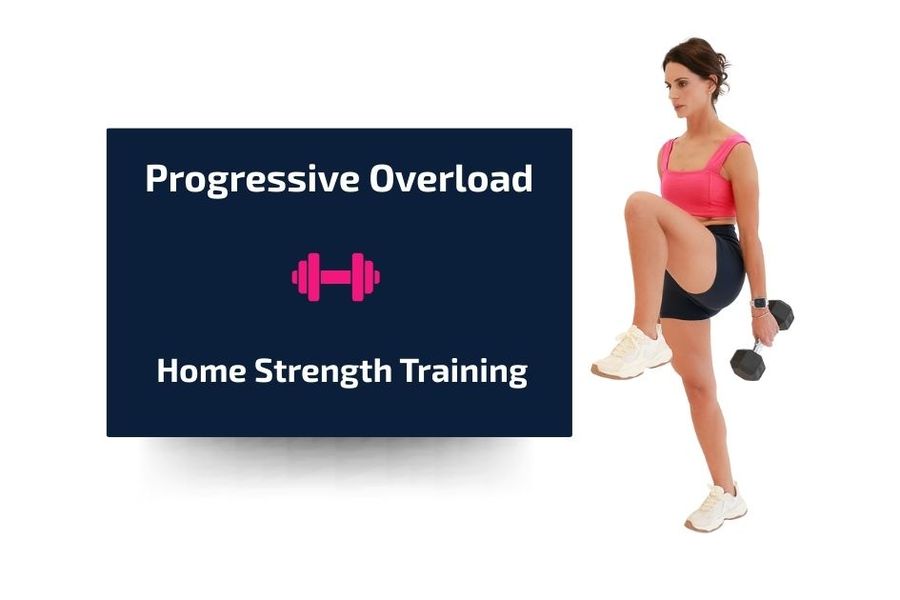
Progressive overload is one of the most talked about concepts in the strength training world, but also one of the most misunderstood - especially when it comes to home workouts. So if you’ve felt confused by progressive overload for home strength training workouts, you’re not alone.
Progressive overload is a principle that applies just as much to home-based workouts as it does to gym-based workouts. It’s often described as something that requires constant increases - heavier weights, more equipment, and a gym environment. This messaging often leads to women, especially in midlife, who strength train from home, feeling like applying progressive overload is unrealistic for them. However, that’s not the case.
The truth is, progressive overload can be applied from home and with minimal equipment, so long as you have the right understanding and approach to it.
What Progressive Overload Actually Means
Progressive overload is the gradual increase of stress placed on the body during resistance training. The goal isn’t to overwhelm the body and constantly be pushing for more; it’s to give it a reason to adapt and grow.
When your muscles are exposed to the same demands repeatedly, they become efficient at meeting those demands. Over time, that efficiency will equate to less stimulus and fewer adaptations. On the other side of the coin, no adaptations can be made if you’re constantly switching up your workouts and exercises and being random with your training. Random training will give you random results. If you have specific goals, you must be specific with your training.
The principle of progressive overload introduces small, intentional changes so that strength can continue to develop over time. This process is slow by design, and some may even call it boring at first, but it’s meant to support long-term health and sustainability, not rapid change. It can be an effective method, and that slow, repeatable progress is what makes strength training after 35 actually stick.
Why Progressive Overload Matters More in Midlife
In midlife, your body’s relationship with stress shifts. Recovery starts to take longer. Hormonal shifts during perimenopause can affect the rate at which strength is gained or maintained, and muscle loss becomes imminent without intentional resistance training. But don’t worry, results are still possible.
Progressive overload helps to counter the natural experiences of aging by providing a steady, manageable signal to preserve and build muscle over time. Rather than relying on intensity and exhaustion like you likely did in your younger years, progressive overload allows you to rely on consistency and progression to obtain results. To be honest, it’s a much better feeling approach to fitness and one that you’ll be far more likely to stick with. This approach respects the realities of midlife women’s bodies. It allows strength training to remain sustainable and approachable instead of something that eventually becomes harder to return to with each restart.
Why Home Strength Training Still Requires Progression
One of the biggest misconceptions out there about home workouts is that they’re inherently limited and therefore won’t be as effective long-term. That, without access to heavy equipment, progression simply isn’t possible, or at the very least, is very limited.
However, the truth is that most home workouts fail not because of access to equipment, but because they lack proper structure. When exercises change constantly, or progression isn’t planned and built into the workouts, your body never receives a consistent enough signal to adapt.
One of the biggest misconceptions about home workouts is that they’re inherently limited. That, without access to heavy equipment, progression simply isn’t possible.
In practice, many home workouts fail not because of equipment, but because they lack structure. When exercises change constantly, or progression isn’t planned, the body never receives a consistent enough signal to adapt.
Progressive overload provides the structure required to make real changes and strength improvements. It gives direction to home training and prevents workouts from becoming random movement sessions that feel busy but aren’t as optimal as they could be.
What Progression Looks Like Without a Gym
No gym? No problem. Progressive overload doesn’t depend on constantly lifting heavier weights (although that can be part of it). When training from home, progression can show up in quieter ways.
Progressive overload for home strength training can mean performing the same movement with more control, improved range of motion, and better form. It can also mean gradually increasing the number of repetitions (reps), adding an additional set, or slowing down your tempo to increase your time under tension.
All of these forms of progression place a meaningful demand on your muscles without requiring you to endlessly pay for home equipment upgrades. Over time, with the right intention and plan in place, these small changes accumulate into real strength gains and physique results.
Why Constantly Changing Workouts Can Stall Strength
Although marketing has made us believe that variety and “keeping your muscles guessing” are benefits in fitness. But when it comes to strength training, too much variety can be a detriment. When the movements you’re performing change every sessionm the body never practices them long enough to improve. Without repetition, there’s no baseline from which progress can be revealed. Progressive overload depends on familiarity - you have to know and understand the movement first and then make subtle improvements and adjustments to keep progress going.
This doesn’t mean that workouts need to be rigid or boring - it means that they need to be structured with enough consistency to allow the body to adapt. Many women who fear that switching from workouts that keep things different week to week to workouts that stay the same are often surprised to find themselves loving the simplicity and “me vs me” approach that’s common to this type of workout. This is especially true for women in midlife and beyond.
Progressive Overload Is Not Linear
A common misconception about progressive overload is that you should be consistently and evenly moving steadily upward, and if you’re not, you’re doing it wrong - more weight, more reps, more intensity - week after week. This, however, is not the case. Progressive overload is not linear, and there isn’t one “right” way to do it.
Progress is highly dependent on a number of factors, including hormonal fluctuations, stress, sleep, nutrition, and life demands - all of which influence performance. Some weeks, your strength will improve. Other weeks, it holds steady. And, occasionally, your strength will dip. This is all normal, expected, and part of the process.
Progressive overload is still at work and making an impact during these normal patters an fluctuations. Maintaining strength during busy or high-stress periods is a form of progress. Returning to prior levels after a setback is still progress. Showing up consistently is still progress and still counts. The absence of a constant upward trend in strength does not mean that the process isn’t working.
The Role of Recovery in Progression
Progressive overload works most optimally when your body has enough recovery to adapt. Without adequate rest, the increased demand that you placed on your body will simply become accumulated fatigue. Muscles repair and rebuild when you’re resting, not when you’re working out, and they need the time and space to do so.
Especially in midlife, recovery needs to be more than just an afterthought. It needs to be an important part of the training process itself. This means that rest days, realistic and manageable volume, appropriate rest times, and intensity all support progression by allowing your body to respond to training rather than resist it. Any strength you build without proper recovery will be short-lived and difficult to maintain. Real, lasting strength and results are built with recovery that’s appropriate and sustainable.
Why Progressive Overload Supports Confidence
Progressive overload builds so much more than just physical strength; it builds familiarity, trust, and confidence, too. Repeating movements allows you to understand how your body moves, what feels stable, and where control improves over time. Strength becomes something that’s observable and internal, not something that can only be measured by external outcomes (i.e., the number on the scale).
This type of confidence might feel unfamiliar at first because it’s not the type that comes from constantly striving to push harder. It comes from noticing the natural progress you’re making without needing to feel like you’re constantly chasing it.
For so many women over 35, training for progressive overload unlocks a whole new level of confidence in themselves and in their ability and strength. It’s a pivotal moment where women discover strength and ability, and the confidence that’s derived from there is so much more impactful than chasing a number on the scale or a certain look in the mirror. And to be able to achieve this from home and with minimal equipment is an incredible feat.
Progressive Overload as a Long-Term Practice
Strength training with an emphasis on progressive overload isn’t something that you “do” for a few weeks or a couple of months and then move on from. It’s the underlying principle that makes strength training work over the years.
For women over 35, especially, this matters. Strength training is no longer just about aesthetics or temporary goals. It’s about maintaining physical strength and capacity through the changing stages of life. It’s about being able to support yourself as you age and grow old more gracefully. And progressive overload, even when done from home, allows strength training to evolve alongside your body, rather than forcing your body to keep up with your training.
How This Fits Into the Bigger Picture of Strength Training
Progressive overload doesn’t exist in isolation - it intersects with nutrition, recovery, hormonal health, and other lifestyle demands. This is why it functions best as one pillar among many, not a singular solution. When understood and applied properly, progressive overload removes pressure and guesswork from strength training. It replaces urgency with direction and allows home strength training to be effective without becoming overwhelming.
Final Perspective
Progressive overload is absolutely possible from home. It’s not about doing more; it’s about smart programming that creates a steady and repeatable signal that strength is still a priority as you age, and that allows your body to respond over time. In midlife and beyond, this approach isn’t just effective, it’s necessary.
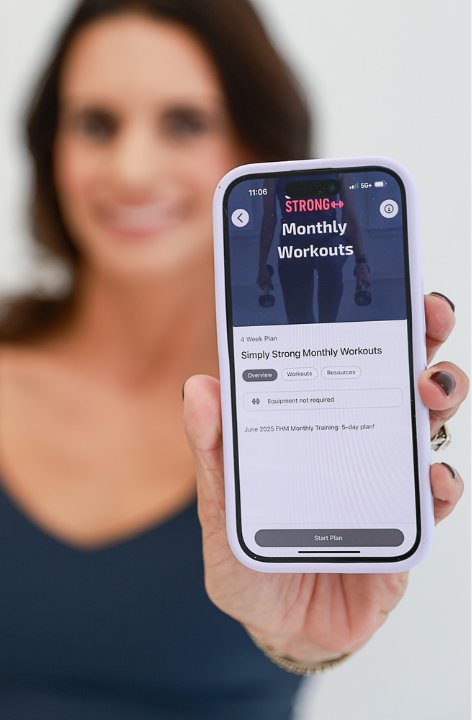
Progressive overload isn’t just about constantly adding more; it’s about setting the intention to make improvements and increases over time, paired with a smart training program that’s designed for women training at home. This is the exact approach that the Simply Strong App takes, and I’d love to welcome you to train with intention with us.