
If you’ve been playing around with strength training for some time now but feel like your results have stalled or that your results have been lackluster, chances are you’ve heard the term progressive overload thrown around in the industry. Oftentimes, it’s explained in a vague way - “lift heavier” - which isn’t all that helpful, especially when you’re training from home with dumbbells and bands.
Here’s the thing, progressive overload is actually much simpler and more realistic than its made out to be. And once you understand what it really means and how to apply it, it’ll become one of the most powerful tools for building strength, muscle, confidence, and a body you’re proud of as you age.
What Progressive Overload Actually Is
At its most basic level, progressive overload is gradually increasing the challenge placed on your body over time so that your muscles are given a stimulus to adapt, change, and grow.
Our bodies are incredibly efficient. If we keep asking them to do the same thing every week, they’ll stop responding because they will have adapted. Progressive overload is the key to preventing that plateau.
It’s not that you should be maxing out every single workout or constantly feeling completely wrecked; it’s an intentional progression - small, strategic changes that are layered and applied over time.
Why Progressive Overload Matters (Especially After 35)
For women in midlife and beyond, progressive overload becomes an increasingly important fitness element. Between hormonal shifts, life stresses, and recovery demands, it becomes incrementally harder to see results if your training plan lacks structure. Random workouts or workouts that constantly switch the exercises might feel fun and productive, but they fail to provide your body with a clear signal to build strength.
Women over 35 need to focus on progressive overload because it:
- Supports lean muscle mass retention and growth
- Improves bone density (a battle we naturally start to lose as we age, unless we intervene)
- Builds true, usable strength as we age
- Increases confidence inside and outside of the gym
And, just so we’re on the same page, adding more cardio isn’t the answer to a strength plateau.
Progressive Overload Is More Than Just Heavier Weights
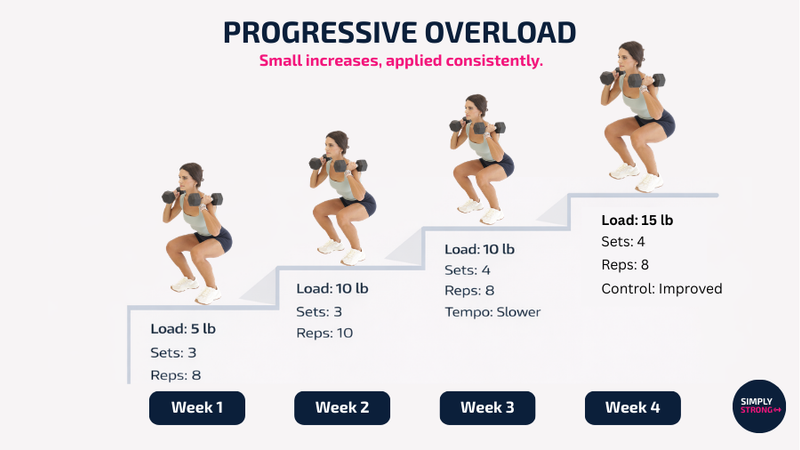
This is the exact spot where most women get stuck. They think that continually lifting heavier weights is the only way to progress. If this were the case, those of us who work out from home would be incredibly limited. Thankfully, simply picking up heavier weights isn’t the only way to make strength gains. You can make progress by:
- Increasing reps within a given range
- Adding an additional set
- Slowing down tempo (especially the lowering phase)
- Improving range of motion
- Reducing rest time
- Improving form and control
Weight increases are just one tool, not the whole toolbox.
Why Repeating Movements Is How You Get Stronger
One of the biggest and most common mistakes women make is constantly switching up their exercises in the name of variety. While variety will always have its place, strength is built through repetition. Repeating key strength training basics like squats, hinges, pushes, and pulls allows you to:
- Track your progress
- Improve your technique
- Build confidence under load
- Apply progressive overload with intention
If every workout features totally different exercises, it’s nearly impossible to track and know whether you’re actually getting stronger.
The Difference Between Sweaty and Effective Workouts
It’s really important to understand that sweat is not a reliable indicator of progress or a “good” workout. A workout can feel hard and leave you feeling totally exhausted without actually driving adaptation, which is a total bummer - who wants to work super hard and not see results?
Truly effective workouts are:
- Structured
- Repeatable
- Progressive
- Aligned with your goal
Progressive overload is what separates “I worked out” from “my body is changing,” and this can be a tough concept to grasp at first, especially if you’ve spent your entire life believing the opposite.
How Long Does Progressive Overload Take to Work?
The short answer: longer than you’d like to think. But this is where patience comes in and your trust in the process. You don’t need to/won’t be able to progress every single workout; we’re not robots. In fact, if that’s your approach, you might even find that it backfires on you.
Most women following a structured, progressive-overload focused workout plan l begin to feel stronger within 3-6 weeks of consistent, well-programmed training. Visible changes (increased muscle definition, decreased body fat, etc.) will typically follow after that. If you’ve been working hard, consistently, and aren’t seeing any changes, it’s probably not an effort issue; it’s the plan (or lackthereof) that you’re following.
How to Know If Your Program Is Missing Progressive Overload
If you’re not sure if the plan or program you’re following is truly a progressive overload plan, ask yourself these questions:
- Am I repeating key lifts week to week?
- Do I know what I’m trying to improve in each workout?
- Is there a plan beyond today’s sweat?
If the answer is no to any/all of these, your program may be the problem, not your consistency.
What Progressive Overload Looks Like Inside Simply Strong
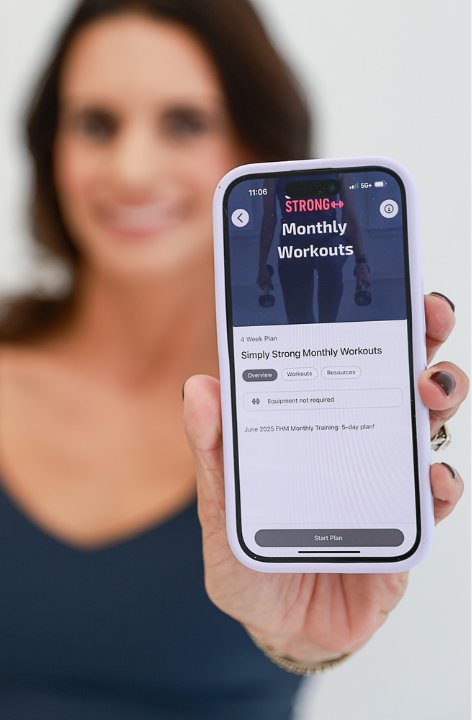
Simply Strong was built on the principle of progressive overload, so you don’t have to overthink it. Workouts are structured around foundational movements and repeated across training phases, with clear progression through reps, tempo, and load. This approach allows you to train at home with dumbbells while still seeing real strength gains.
As we age, we don’t always need harder workouts; we need smarter ones that actually cater to and work with our aging bodies, not against them. The concept of progressive overload is not complicated, but it does require intention on your part. And when your workouts follow a structured, progressive plan, your body finally has a reason to change.
If you’re ready to move beyond random workouts and start training with purpose, consider joining us in the Simply Strong App.