
Quick Summary
If you're working out consistently but not seeing results, the problem could lie in your approach to fitness. Workout repetition and progressive overload are game-changers for women over 35 who want efficient results.
One of the biggest myths that women have been led to believe about fitness is that they need a completely different workout every day to see results. That your muscles need to be “confused” in order to be challenged into changing. We’ve been taught that if a workout feels familiar, it’s no longer working.
So what happens is we see women jump from program to program, saving random workouts from social media, and constantly searching for something new to try. But here’s the thing: your body doesn’t get stronger from constantly switching up the exercises you’re doing. It gets stronger from practicing them.
If you’ve ever wondered whether or not no-repeat workouts are effective, understanding how your body actually adapts to training can completely change your approach to strength training.
Why We Think We Need Constantly New Workouts
Fitness culture has spent years selling us on the idea of “muscle confusion,” which is essentially the concept that your body needs to be constantly surprised in order to continue making progress.
While variety has its place and can be helpful in some situations, a lot of women have taken this concept too far. Instead of following a structured program, they end up doing:
-Different exercises with every workout
-Random YouTube or social media workouts
-Program hopping every few weeks because they’re “bored” or not seeing results
The result is often a lot of effort without much measurable progress.
To add insult to injury, many women also incorrectly assume that they need to be drenched in sweat or completely exhausted for the workout to be effective. And this is where progress starts to stall, and women start to feel like they’re spinning their wheels. The most effective workouts aren’t necessarily the sweatiest ones; they’re the ones that allow you to improve over time.
Related: The Difference Between Sweaty and Effective Workouts
Your Body Learns Through Repetition
To simplify this a bit, think about learning any new skill. If you wanted to get better at playing pickleball, would you practice a different sport every day? If you wanted to improve your golf swing, would you do it only once? Of course not. Strength training is the same concept.
Your body needs to be given opportunities to practice movement patterns repeatedly so it can become more efficient and stronger. Every time you perform a squat, row, shoulder press, or deadlift, you’re teaching your body how to execute that movement more effectively. That’s where progress starts, but it doesn’t end there, because every time you do it, you’ll be focusing on adding volume or load to provide a stimulus for change.
Repetition Builds Better Form
One of the biggest and most underrated benefits of repeating workouts is that it helps improve your technique. Proper form and technique are critical for results as well as injury prevention.
The first time you perform an exercise, you’re often focused on simply figuring it out. The second time, you become more comfortable with it. The third, fourth, and fifth times, you’re focused on refining the movement and getting stronger with it.
Over time, you may notice the following:
- Better balance
- Improved stability
- Greater range of motion
- Increased confidence
- Better mind-muscle connection
None of that is possible if you’re not willing to repeat the same exercises.
Repetition Makes Progressive Overload Possible
Progressive overload is one of the most important principles of strength training. In simple terms, it’s the gradual increase in the challenge placed on your muscles over time. This can be accomplished by doing the following:
- Increasing weight
- Adding reps
- Adding sets
- Improving control
- Increasing the time under tension (slowing the movement down)
This is why repeating workouts works so well for body composition changes and muscle growth. You are gradually increasing the demand on your muscles over time, providing them with the stimulus and signal they need to grow and change. This is not possible if you’re constantly changing the exercises you’re doing.
Related: What Progressive Overload Really Means
Why Random Workouts Often Lead to Plateaus
A lot of women think they get stuck because they need a harder workout, when in reality, they stop seeing progress because they don’t have a clear way to measure whether they’re improving.
Related: Why You Feel Stuck Even Though You're Working Hard
When the workouts you’re following are random and sporadic:
- Strength is difficult to track
- Progress becomes unclear
- Confidence decreases
- Motivation drops
You may be working hard, but hard work alone doesn't guarantee results. Your body responds best to consistency paired with gradual and intentional progression. Over time, doing random workouts will make it difficult to tell whether the issue is your effort level or the program itself.
What Repeating Workouts Actually Looks Like
First, it’s not boring, you just need a mindset shift! Repeating workouts doesn’t mean that you’re doomed to do the exact same workout forever. It means that you’re following a program long enough to allow for adaptation.
For example, you might perform:
- Goblet squats for four weeks
- Romanian deadlifts for four weeks
- Dumbbell rows for four weeks
- Shoulder presses for four weeks
As the weeks progress, you increase the challenge through weight, reps, sets, tempo, or control.
Then, eventually, the program evolves, the exercises change, but the progressive approach remains intentional. Most programs will switch up the programs every 4, 6, 8, or 12 weeks. Many women worry about being too bored or that they won’t be making progress, but it’s the opposite that’s usually true. There’s a lot of confidence and “fun” to be found in mastering movements and seeing yourself improve week after week.
Why This Matters Even More in Midlife
For women over 35, consistency and intentionality matter more than intensity. Recovery will naturally take longer, schedules are usually busier, and energy levels often fluctuate. This is why constantly chasing new workouts and more intensity often becomes a big source of stress and frustration among the midlife crowd.
In this stage of life, structured repetition provides familiarity, confidence, and measurable progress without requiring you to start over every single week. Instead of guessing if the workout is working, you will clearly be able to see your strength improving over time.
This is one reason why many successful strength training programs rely on repeating key movement patterns over several weeks before introducing new progressions.
Simple Structure and Progression Create the Best Results
The workouts that produce the best results are not the flashiest and most exciting; they’re the ones that you repeat consistently enough to get better at them. Strength isn’t built through endless variety; it’s built through practice, progression, patience, and trust in the process.
And if you feel like you’re being so consistent but aren’t seeing the results you want, the answer is probably not to work harder; it’s to follow a more structured plan and be willing to repeat.
Related: Why Consistency Alone Isn't Enough
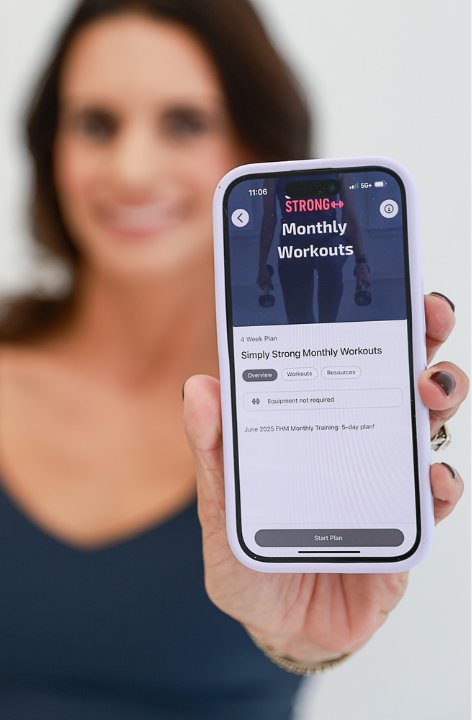
If you’re looking for a strength training program for women that takes all the guesswork out of progressive overload and results, take our quick quiz to see if the Simply Strong App is the right fit for you.