Quick Summary
New to strength training? This beginner-friendly plan for women includes three full-body workouts per week, a simple four-week progression, and a free printable PDF with exercises and a workout tracker. Build confidence, learn proper form, and create a consistent strength training routine at home.
When you’re new to strength training, trying to figure out where to start can feel overwhelming. It’s difficult to know what exercises to do, how many days per week to train, what weights to use, and whether or not you’re doing enough.
While you might feel a little lost, I want to reassure you that it’s really not as complicated as you think, and you don’t need much to get started on the right track. When you have a simple, consistent fitness routine to follow that’s designed to help you build muscle, improve your strength, support your bone health, and feel more confident in your clothes, a lot of the questions and overwhelm disappear.
In this article, I’m sharing a free beginner strength training workout for women PDF that includes 3 full-body workouts, a four-week schedule, and a workout tracker so you can track your strength progress. But first, I want to talk about what you need to get started strength training at home so you have everything you need to hit the ground running with your free workout PDF.
What You Need to Start Strength Training at Home
One of the best things about strength training at home is that you don't need a lot of equipment to get started. For this beginner dumbbell workout plan, you'll need:
- Dumbbells: A light-to-moderate pair to start. You may eventually want multiple weight options because different exercises require different levels of resistance.
- Bench or sturdy chair: Useful for supported exercises, step-ups, and incline push-ups.
- Floor space: Enough room to move comfortably through your exercises.
It takes less than you think to get started!
Your Beginner Strength Training Workout for Women
This plan includes three full-body workouts designed to be completed on nonconsecutive days (aka make sure you give yourself a rest day from weights in between workouts!).
Each workout includes a combination of lower-body, upper-body, and core exercises so you're training all your major muscle groups throughout the week appropriately. The goal as a beginner is to learn the movements, practice good form and technique, and gradually build strength over time.
Workout A
- Goblet squats 2 x 8-10 reps
- Chest press 2 x 8-10 reps
- Single-arm dumbbell rows 2 x 8-10 reps each arm
- Glute bridge 2 x 12-15 reps
- Dead bugs 2 x 12 reps (alternating sides)
Workout B
- Step-ups 2 x 8-10 reps each side
- Shoulder press 2 x 8-10 reps
- RDL 2 x 8-10 reps
- Reverse fly 2 x 8-10 reps
- Plank hold 2 x 30 seconds
Workout C
- Reverse lunges 2 x 8-10 reps each side
- Incline push ups 2 x 8-10 reps
- Banded pull-aparts 2 x 10-12 reps
- Banded lateral walks 2 x 12-16 reps (alternating sides)
- Side plank holds 2 x 30 seconds each side
A few things to remember: These workouts are meant to be approachable and foundational. You don't need to rush through them, use heavy weights, or push yourself to exhaustion. Instead, focus on controlled reps and using good technique. I recommend resting for 45-90 seconds between sets so you can attack your next set with energy. The best way to enjoy this workout plan is by downloading the free PDF!
Your Four-Week Beginner Strength Training Schedule
For most beginners, training 3 days per week is a very practical starting point - especially for women over 35 with busy schedules. At this stage of life, working out every day is not only not realistic, but it’s also not sustainable, as rest days are required to allow your body to recover and strengthen.
You may structure your week of workouts however you wish, but here’s a common example schedule for beginners using the 3 workouts outlined above:
Monday: Workout A
Tuesday: Active recovery day (walking or other movement you enjoy)
Wednesday: Workout B
Thursday: Active recovery day (walking or other movement you enjoy)
Friday: Workout C
Saturday: Rest
Sunday: Rest
If you're completely new to exercise or returning after a long break, you can start with just two strength workouts per week, and add the third when you feel ready. The goal is simply to establish a routine that you can repeat consistently, not to do as much as possible right out of the gate.
How to Progress Over Four Weeks
Women don’t need a completely different workout routine every week to “keep their muscles guessing”; that’s a myth. In fact, it's in the repetition of doing the same exercises week to week that you get the opportunity to practice your technique and actually see and measure your strength increases.
Here’s how I recommend approaching your 4-week workout plan:
Week 1: Learn the movements
Complete two sets of each exercise. Choose manageable weights and focus on learning the movements. Don't worry about lifting heavy right now.
Week 2: Build consistency
Repeat the same workouts. If the exercises are feeling comfortable, try adding one or two reps to some of your sets while maintaining good form.
Week 3: Gradually increase the challenge
As you become more comfortable, you may be ready to increase your dumbbell weight or resistance band tension. You don't need to increase resistance for every exercise at once; just choose the ones you’re ready for.
Week 4: Review your progress
Repeat the workouts and compare your performance with the first week. Are you completing more reps? Using slightly heavier weights? Feeling more confident with the exercises? Becoming less sore?
Those are all signs that you're building experience and strength.
How Heavy Should Your Dumbbells Be as a Beginner?
One of the most common questions I get from beginners is how heavy their dumbbells should be. And I know you want a specific answer, but the truth is, it depends. There isn’t one perfect dumbbell weight for everyone - it depends on your current strength, the specific exercise you’re performing, and what your goals are.
I recommend choosing a starting weight that allows you to complete your target reps with control while making the final few reps feel challenging (you should be ready for a break by the end!).
Here are a few guidelines:
- If you can easily complete every repetition without feeling challenged, the weight may be too light.
- If you're swinging the dumbbells, rushing, or changing your technique to finish, the weight may be too heavy.
- If you're unsure, start lighter and focus on learning the movement before increasing resistance.
As you become stronger, you can gradually increase your weights or reps to make the exercise feel appropriately challenging for you. Lifting weights isn’t just about seeing how heavy you can go; it’s about applying a challenging load that allows you to make consistent progress.
Common Beginner Strength Training Mistakes to Avoid
When you're starting a new fitness routine, it's easy to assume that more is always better. But you don't need to make every workout intense or change your entire lifestyle overnight - that usually leads to burnout and giving up.
Here are a few common mistakes to watch for.
1. Doing Too Much Too Soon
Starting with five or six workouts per week when you're used to doing very little can make it difficult to recover and stay consistent. I recommend starting with two or three strength sessions and building from there. It’s a much more sustainable way to get started and ensure long-term consistency.
2. Changing Your Workouts Constantly
It can be tempting to try a different workout every time you exercise (no-repeat workouts), especially when there are so many options available online. But constantly switching up the exercises you’re doing makes it really difficult to track your progress and actually gauge whether or not you’re getting stronger.
3. Choosing Weights That Are Too Heavy
You don't need to lift the heaviest dumbbells you can find to get results, especially if you’re just beginning a strength training program. Instead, start with weights that you can control and that allow you to perform the exercises with good form.
4. Thinking You Need to Be Sore After Every Workout
Muscle soreness doesn’t equate to a “good workout.” While you may experience soreness when beginning a new workout routine, it’s unlikely that you’ll be sore after every session, and that’s a good thing. Focus on training consistently and looking for ways to gradually add progressive overload instead.
5. Ignoring Recovery
Rest days are not wasted days, and they don’t mean you’re lazy or losing progress. In fact, your body needs rest days to recover properly between challenging strength sessions. On your rest days, you should be prioritizing sleep, getting adequate nutrition, and still maintaining some level of activity (you don’t need to just lie around on the couch all day). Walking or another form of gentle movement is great for rest days from strength training.
What Should You Do After Your First Four Weeks?
Once you've completed the beginner plan, you have a few options. You can repeat the workouts and continue increasing your weights or repetitions as appropriate, or you can move into a more comprehensive strength training program with additional exercises and a longer-term progression strategy. Either way, the goal is to keep building on what you’ve started.
As you gain experience, you may find that you want more variety, additional training days, or a program that gives you a clearer path for continued strength development; this is where having a structured workout plan becomes especially helpful. Rather than piecing together random workouts or hopping from program to program, look for a program that tells you what to do, how often to train, and how to progress over time. Choose a plan that aligns with your goals, your desired training frequency, and your equipment availability (home vs. gym).
Ready to Build on Your Beginner Strength Training Routine?
Download my free Beginner Strength Training Workout for Women, which includes the 3 workouts outlined above as well as links to form cue videos and a tracking sheet so you can keep tabs on your progress.
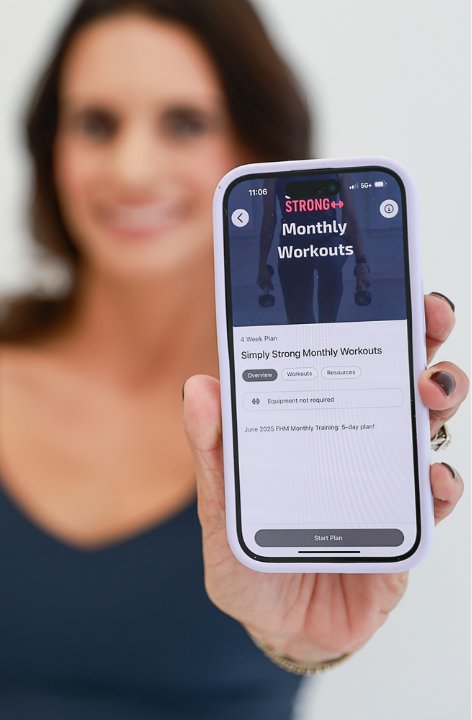
Once you’ve completed your 4-week plan and you’re comfortable with the basics, consider moving into a more structured and progressive program that helps you continue to build strength month after month, like the one I offer in my monthly strength training membership inside the Simply Strong App.
Take this quick quiz to see if you’re ready now!