
One of my very first real weight training experiences came via Madeline Moves App (now just “Moves App”) back in 2019. I was newly postpartum with my second baby and really wanted to focus on getting stronger and more “toned.”
I had started following Madeline on Instagram and really liked the style of the workouts she was sharing and her body composition results, so I decided to give Madeline Moves a try. Years later, I no longer use the Moves App, but follow the workouts in the Simply Strong App instead.
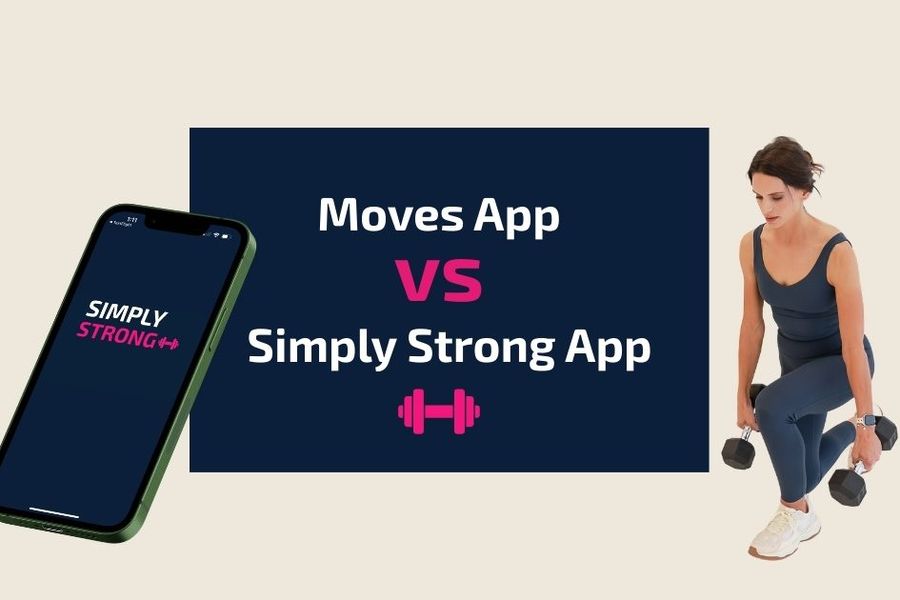
There are some similarities between Moves App and Simply Strong App, but also a lot of differences in the overall approach - neither being right or wrong, just different. I get asked all the time about my experience with Moves App and how it differs from the Simply Strong App, so I figured I’d write it all out.
My Experience Using Madeline Moves
Back in early 2019, I was postpartum and wanted to drop the “baby weight.” I had been messing around with dumbbell workouts at home, doing random Beachbody workouts, and free YouTube workouts. I grew up in the era of “weights will make you bulky,” so there was a lot of hesitation and resistance to really go all in on a strength training program on my end, despite the fact that I was well-educated on the importance of strength training having gotten my personal training certification a few years prior so I could teach in-person group fitness classes locally.
I had discovered Madeline on Instagram and quietly watched her workout from her garage gym for a few months before I decided to give her app a try. She announced a Tighter Together Challenge, and I decided that would be the perfect time for me to jump in, give it a try, and see where it takes me. The Tighter Together challenge included 4 weeks of strength training workouts in the Moves App, plus a custom macro count.
Prior to trying Madeline Moves, the only workouts I did at home were follow-along videos where you work out with the instructor - Moves App’s workouts are not follow-along, they are go at your own pace, which was a big change for me and something that I wasn’t sure I was going to like. But I trusted the process and went all in. To make a long story short, I ended up really enjoying the Tighter Together Challenge - the workouts took me about an hour each to complete, they were intense, challenging, and always left me feeling accomplished. After the challenge was over, I decided to become a monthly member in the Moves App.
The monthly membership is called Weekly Moves, and the name pretty much encompasses the concept - each week you get a new set of “moves” or workouts to do. At the time, I loved the novelty of doing different workouts each week. The thought of repeating workouts sounded really boring and unmotivating to me, so this was something I was very on board with. I started following the weekly moves workouts consistently, working on getting stronger, and started to see great results (increasing muscle, decreasing body fat). There was a lot of high-intensity exercises and exhausting circuits, which, at the time, I really enjoyed and didn’t mind that the workouts took me over an hour to complete - or, at least, I just accepted that the workout time was a requirement for success and did it anyway.
I ended up following Madeline Moves workouts until 2022, at which time my body started to change and respond differently to the training style. I was reaching my mid-30s at this point, and I was noticing some pretty drastic changes in my body hormonally and how it responded to intense workouts. I had also spent a lot of time continuing my education in the fitness space and knew that the level of intensity in the Moves App workouts was likely working against me at that point and that I needed to scale things back and make adjustments that would better support my aging body.
Switching to Progressive Overload Workouts
Over the course of the time that I spent following the Weekly Moves workouts in the Moves App, I would hear over and over again about progressive overload, aka increasing the load on exercises over time. In order to properly apply progressive overload, you need to repeat the same exercises each week for a period of time, but I wasn’t doing this in the Moves App because the exercises changed every week, making it very difficult to track and apply progressive overload.
From a personal standpoint, while I had gained a lot of muscle during my time using Moves App, the last year or so with it left me about 15-20 lbs heavier than I started - and let me be clear, I am not blaming the workouts solely for that! The cause of my weight gain was multi-pronged - I was getting older, my hormones were raging, I was working out for long periods of time (adding cardio after my Moves workouts), my appetite was out of control, my body was constantly inflamed (rings always tight), I was eating in a calorie surplus, and I wasn’t making any kind of positive progress.
I was so frustrated and defeated and had exhausted all my efforts to “do more” to see results, and knew that I needed to scale things back, simplify, and make some big changes to accommodate my current physical state better. Although I was nervous to do so, I decided I needed to cut back on my workouts, taking a more progressive approach, and allow my body the space it needed to feel safe again.
I started looking for a progressive overload-focused strength training program that I could do from home with dumbbells and bands, and was having a really hard time finding what I was looking for. Most of the programs I found and tried required access to gym equipment, didn’t come with an easy-to-follow app that allowed for tracking (most were PDFs), repeated for 8-12 weeks (which felt too long for me), or cost a lot of money each month ($50+).
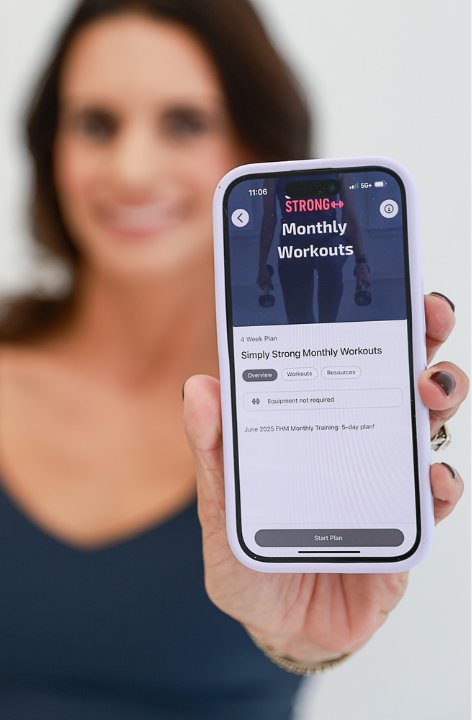
So, being that I was a certified personal trainer and macro coach at this point, I decided that, since I couldn’t find exactly what I was looking for in a workout program, I would create my own and put it in an easy-to-use app. This was the birth of the Simply Strong App.
Strength Training in the Simply Strong App
I have been consistently following the workouts in the Simply Strong App since August 2023, when I launched the app. Having had years of experience using other apps like Madeline Moves and having the education and personal experience of an aging body that didn’t respond so well to intense workouts any longer, I knew exactly what I wanted to offer in the Simply Strong App.
The workouts needed to:
- Be progressive overload focused - so they would repeat for a month at a time, so users could work on getting stronger within each exercise over the course of a month, but not any longer, because boredom can start to creep in around week 4-5. Progressive overload is key for muscle growth and development, which is critical for women over 35 to protect their bodies and metabolisms as they age.
- Be realistically time-bound - as a busy, full-time working mom, I needed workouts that took me no more than 45 minutes each morning. The Simply Strong App would have two daily workout options: ~45 minutes or ~30 minutes (depending on individual pace).
- Include basic strength exercises done in single sets, not a ton of supersets and circuits - true progressive strength training involves working in single sets (doing one exercise at a time and resting between sets). Programmed rest times between sets were a non-negotiable.
- Be 100% doable from home - no fancy equipment requirements that would deter or discourage, just dumbbells, bands, and some form of step, bench, or elevated surface.
- Be doable for all training and age levels, beginner to advanced - the utilization of basic, proven strength exercises allows users of all ages and experience levels to start from where they are and work on making progress along their own timelines.
- Be hormone-friendly - Intense workouts after a certain age (roughly 35+) can start to produce unwanted effects, especially as we approach perimenopause and beyond. A strategically gentler approach can produce far better results and a lot less wear and tear on the body.
- Include warm-ups and cool-downs - as aging women, we need to be doing structured warm-ups before our workouts and then cool-down stretches after, and they need to be programmed in so we’re not tempted to skip them.
My Results Using the Simply Strong App
While completely changing my training style took some time to get used to and required me to trust the process, my body has completely transformed over the last few years of consistency with the Simply Strong App. Not only did I drop the 15-20 lbs I had gained, but I have more muscle definition, balanced hormones, and a lot less fitness “stress” in my life.
I strictly do the 30 minute versions of the workouts in the Simply Strong App and follow them 4-5x per week. I supplement my Simply Strong workouts with a daily step goal - no intense cardio - and my body, from a hormonal standpoint, has never been more at peace. I take at least 2 full rest days per week, I work hard and lift heavy within each set, and take my programmed rest times between them. The slower, more intentional pace has proven to be the thing I needed to get myself off the hamster wheel of always trying to do more.
While I loved Madeline Moves and am so grateful for the program and the way it introduced me to strength training, it is no longer a good fit for the stage of life I am currently in. That’s not to say that the Moves App wouldn’t be a great fit for you - we all have different bodies and different experiences. However, the majority of women 35+ whom I speak with find themselves in a similar position I was in - they want more intentional, structured workouts that feel less intense and more tailored to their needs. They want less drama and more results.
If this sounds like you, I’d love to welcome you to give the Simply Strong App a try.
Simply Strong App vs Moves App
| Feature | Simply Strong | Moves App (Madeline Moves) |
|---|---|---|
| Training Philosophy | Built around progressive overload strength training. Workouts repeat for several weeks so users can track weights and gradually increase strength over time. | Focuses on variety with new workouts introduced frequently. Programs blend strength, conditioning, and mobility for a well-rounded routine. |
| Programming Progression | Exercises repeat for multiple weeks, making it easier to track strength gains and apply progressive overload. | Workouts change frequently, which keeps things fresh but can make it harder to consistently track strength progression on the same movements. |
| Weekly Workout Structure | Options for 3, 4, or 5 workouts per week. Split includes lower body, upper body, and full body depending on program choice. | Typically 5 workouts per week including lower body, upper body, conditioning, and full-body sessions with a mix of strength and cardio-style training. |
| Workout Length | Designed to be efficient and typically takes about 30–45 minutes, making it manageable for busy schedules. | Often listed as 30–60 minutes, but many users report they frequently take longer due to the number of exercises and sets included. |
| Equipment Needed | Dumbbells, resistance bands, and a bench. Designed primarily for home workouts. | Dumbbells, bands, bench, and sometimes additional equipment such as a medicine ball. |
| Workout Variety | Structured format that repeats for several weeks to build strength and confidence with key movements. | High variety with new movements and workouts regularly introduced. |
| Programs Available | Monthly strength-focused programs plus beginner programs, menopause programs, core add-ons, and mobility add-ons for customization. | Multiple options including beginner programs, endurance-focused training, prenatal/postpartum options, and weekly workout programming. |
| Progress Tracking | Allows users to track weights and workouts to monitor strength progression over time. | Allows users to log workouts and track progress within the app. |
| Nutrition Support | Includes a large library of macro-friendly, high-protein recipes designed to support fitness and nutrition goals alongside workouts. | Primarily focused on workout programming and does not include a built-in recipe or nutrition library. |
| Best For | Women who want structured strength training, progressive overload programming, flexible 3–5 day options, and integrated nutrition support. | People who enjoy frequent workout variety, longer workouts, and a mix of strength and conditioning. |
| Price | $24.99 per month, workouts + recipe library included. | $20 per month. |