
Most women, when they begin strength training, understand that they’ll need to increase their load in order to progress, but that raises the question: how do I know when it’s time to make a workout harder?
When following a strength program, you’ll eventually reach a point where the exercises you’re doing will start to feel easier (yay!). But this also means that your body has adapted to the challenge you’ve been giving it, and it’s ready to take on more.
This is where progressive overload comes in. Progressive overload is the gradual increase in demand placed on your muscles over time so that they can continue to adapt and grow stronger. The most common way to accomplish this is to add weight, reps, or sets to the workout. Understanding when and how to adjust each of these variables will help you keep making progress in your workouts.
When to Increase Reps
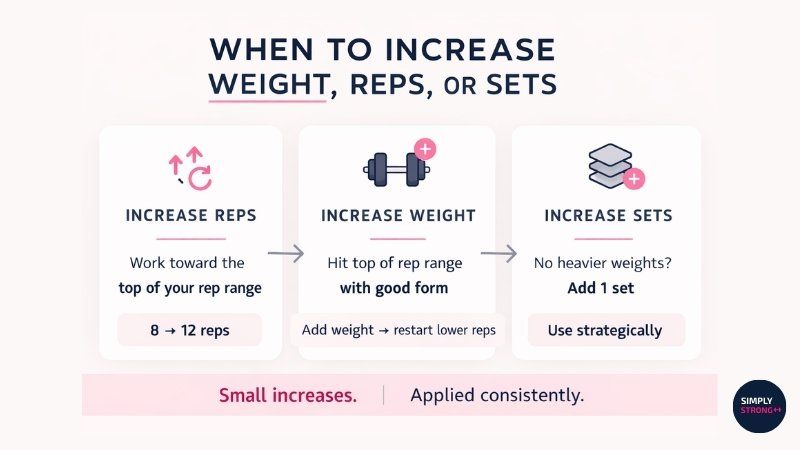
Increasing reps is usually the simplest and most practical way to begin your progression, especially when you’re strength training at home with minimal equipment. Most training programs use a rep range like 8-12 reps for the big lifts. If you’re stopping at the lower end of that range and aren’t feeling challenged any longer, your first progression step might be to gradually work your reps up to the higher end of the rep range.
For example, if you have been doing goblet squats for 8 reps and they feel manageable, easy even - you might go for 9-10 reps the next time you do them. Once you get to the point where you can complete 12 controlled reps with good form, you’ve essentially “maxed out” that rep range, and it’ll be time to move on to another form of progression.
Starting with increasing your reps works well because it builds endurance within that specific exercise while also reinforcing proper technique. This approach to progression also allows you to continue progressing even when you don’t have a lot of heavier weights available.
Increasing reps works well because it builds endurance within the movement while reinforcing good technique. It also allows you to continue progressing even if you don’t have heavier weights available.
When to Increase Weight
Increasing weight is another common and approachable form of progressive overload. If you get to the top of your rep range in an exercise with strong, controlled form, it’s probably time to consider picking up heavier weights.
For example, if you’re following a program that calls for 8-12 reps and you can complete all 12 reps comfortably for multiple workouts in a row, adding weight is your next logical step. Keep in mind that when you increase your weight, you should be returning to the end of the rep range again and building your way up from there. This is what creates a cycle of progression: build reps, increase weight, and then build reps again.
With this approach, you’re developing strength gradually and safely, not jumping too quickly into heavy loads that can potentially compromise your form and lead to injury.
When to Increase Sets
The next progression concept is to increase the overall volume of your workout by increasing the number of sets you’re performing. Increasing volume simply means your muscles are performing more total work.
This strategy comes in handy when you’ve already reached a comfortable rep range and have “maxed out” your available dumbbells at home - the next step would be to add an additional set to your overall volume.
For example, if you’ve been doing three sets of RDLs, you’re at the top of the rep range, and you’re using your heaviest weights - you can increase your number of sets to four and thereby increase your overall volume without changing the load.
This strategy of increasing your sets should be used strategically, not constantly. Too much volume can quickly make a workout unnecessarily long or can lead to over-training. You shouldn’t expect to be able to add more sets every time you do a workout, nor should you expect to be able to do it with every exercise.
Signs It’s Time to Progress
Strength training is unique in that only you can truly determine when to increase your weight, reps, or sets, but there are a few things you can look for to make your progression feel natural.
First, if an exercise feels stable and controlled from the first rep to the last rep, it’s probably time to progress in some form. You should be challenging yourself. If you’re noticing that you can finish your sets without needing much rest in between or that your last few reps feel easy breezy, it’s time to ramp up the challenge.
Another sign that it’s time ot increase the challenge is when your form remains solid, even as you get your last few reps in. If your first reps look identical to your last reps (no struggling), you’re ready for more of a challenge.
Progression won’t and shouldn’t happen in every single workout, but over time, the goal is to gradually move forward so your body is continually having to adapt to new stimuli and continue to grow.
Why Progression Matters for Midlife Women
For women in midlife and beyond, progressive overload is especially important. Hormonal changes during this time can affect muscle mass and metabolism, making strength training one of the most valuable tools for maintaining physical fitness and ability through aging.
That being said, your strength won’t continue to improve if you’re simply picking up the same weights, performing the same reps/sets, and not actively seeking ways to advance. Our bodies are really smart and adapt really quickly, and once it adapts to the stress you’re placing on them, they will require a new challenge in order to continue progressing. Increasing reps, weight, or sets provides that challenge in a controlled and sustainable way.
Keep Progress Simple
Progress is really straightforward, but also highly individualized. You might make progress in some exercises really quickly and then struggle to improve on others; this is all normal and to be expected. There’s no “right” or “wrong” way to do this; it’s all based on your ability.
But, overall, it’s not very complicated: work toward the top of your rep range. Once you reach it with good form, increase the weight if possible. If heavier weights aren’t available, add reps or an extra set. Over time, these small adjustments and intentional progressions will compound to create noticeable strength gains.
Progressive overload isn’t some kind of linear process, and it doesn’t require perfection. All that’s required is that you pay attention to your workouts and keep giving your muscles a reason to continue to adapt.