Quick Summary
Want stronger, more defined arms after 40? These nine effective strength training exercises target your triceps, biceps, and shoulders to help build muscle and improve arm definition. Learn how to perform each movement and why consistent strength training, progressive overload, and balanced nutrition matter more than endless arm workouts.
If you’ve noticed that your arms look or feel different in your 40s than they did in your 20s or 30s, you’re definitely not alone. The fact of the matter is that muscle mass, body composition, and skin elasticity can all affect how your arms look as you get older. For many women over 40, their upper arms are an area where they’d like to get stronger and feel more confident about.
The good news? You can absolutely build stronger, more defined arms with the right strength training routine.
While no exercise can specifically burn fat from your upper arms, you can strengthen and build muscle in your biceps, triceps, and shoulders. Over time, developing those muscles can improve the appearance of your arms and contribute to a stronger, more toned, and capable upper body.
In this article, I'll walk you through nine of the best exercises for “flabby” arms over 40, how to perform each one, and how to put them together into a simple arm workout you can do at home.
Why Do Arms Become Flabbier After 40?
To be honest, I don’t love using the term “flabby,” but that’s what most women refer to increased body fat around their upper arms. Unfortunately, there isn’t a single reason we can pinpoint that would explain what makes your arms look different as you get older, as there are several factors that contribute to changes in the appearance of your upper arms, including:
Changes in muscle mass: Muscle mass naturally tends to decline with age, particularly when you're not regularly challenging your muscles through resistance training. Less muscle can affect the shape and firmness of your arms.
Changes in body composition: Your body's fat distribution can change over time. Some women notice more fat accumulating around their upper arms, midsection, or other areas as they move through their 40s and beyond.
Changes in skin elasticity: Skin gradually loses some of its elasticity as you age. This can contribute to loose or sagging skin, even if you're maintaining a relatively stable weight.
Hormonal changes: The hormonal fluctuations associated with perimenopause and menopause can influence body composition and where you tend to store fat. These changes can make it feel like your body is responding differently than it used to.
The important thing to understand is that these changes don't mean you're destined to lose strength or muscle definition and never experience more toned arms. Strength training is one of the best tools you have to maintain and build muscle while also sculpting your body as you age
Can You Actually Get Rid of Flabby Arms?
Let me make sure we’re really clear here: You cannot spot-reduce fat. This means that doing endless tricep kickbacks, bicep curls, or shoulder presses won't specifically burn the fat covering your upper arms. Your body determines where it loses fat, and no individual exercise can control that process.
However, you can absolutely build muscle in the areas you're looking to improve. For more defined arms, I recommend focusing on two things:
- Building muscle through strength training. Doing exercises that target your biceps, triceps, and shoulders helps develop the muscles that give your upper arms shape.
- Supporting healthy overall body composition. If reducing body fat is one of your goals, nutrition, daily activity, adequate protein, and regular exercise all play a role.
It's also important to have realistic expectations. Strength training can improve muscle development, but it won't necessarily eliminate loose skin. Your genetics, age, and individual skin elasticity all influence how your arms look.
9 Best Exercises for Flabby Arms Over 40
Thankfully, you don't need complicated exercises or fancy equipment to strengthen your arms. All you need are some dumbbells and a bench or sturdy chair at home to get started.
The following nine exercises target the major muscles of the upper arms and shoulders, giving you a well-rounded approach to building stronger, more defined arms.
1. Dumbbell Bicep Curls
Bicep curls are one of the most effective exercises for strengthening the front of your upper arms. They isolate the biceps, making them a great addition to an upper-body strength routine.
How to do them:
- Stand tall with a dumbbell in each hand and your palms facing forward.
- Keep your elbows close to your sides.
- Bend your elbows to curl the weights toward your shoulders.
- Slowly lower the dumbbells back to the starting position.
- Avoid swinging your body or using momentum to lift the weights.
Recommended reps: 2-3 sets of 10-12 reps.
Trainer tip: Keep your elbows relatively still throughout the movement. If you have to lean backward or swing your weights to finish a repetition, the dumbbells may be too heavy.
2. Overhead Tricep Extensions
If your goal is to strengthen the back of your upper arms, don't skip tricep exercises. The triceps make up a large portion of the muscle on the back of your upper arm, and overhead extensions are a great way to target them.
How to do them:
- Stand or sit tall while holding one dumbbell with both hands.
- Raise the dumbbell overhead with your arms extended.
- Bend your elbows to slowly lower the weight behind your head.
- Keep your upper arms close to your ears as comfortably as possible.
- Extend your elbows to return the dumbbell overhead.
Recommended reps: 2–3 sets of 10–12 reps.
Trainer tip: Focus on bending and straightening your elbows rather than moving your entire upper arms. Choose a weight that allows you to control the lowering portion of the exercise.
3. Dumbbell Lateral Raises
Your shoulders play an important role in the overall appearance of your upper arms. Lateral raises target the side deltoids, helping build shoulder strength and definition.
How to do them:
- Stand with a dumbbell in each hand and your arms resting at your sides.
- Keep a slight bend in your elbows.
- Raise both arms out to the sides until they reach approximately shoulder height.
- Slowly lower the dumbbells back down.
- Avoid shrugging your shoulders or swinging the weights.
Recommended reps: 2-3 sets of 10-15 reps.
Trainer tip: This is one exercise where you may need lighter weights than you expect. Start with a manageable dumbbell and prioritize controlled movement over lifting heavier.
4. Dumbbell Tricep Kickbacks
Tricep kickbacks are another great option for targeting the back of your upper arms. They're especially useful for practicing controlled elbow extension.
How to do them:
- Hold a dumbbell in each hand and hinge forward slightly at your hips.
- Bend your elbows and bring your upper arms alongside your torso.
- Extend your elbows to straighten your arms behind you.
- Pause briefly while squeezing your triceps.
- Slowly bend your elbows to return to the starting position.
Recommended reps: 2-3 sets of 10-12 reps.
Trainer tip: Keep your upper arms stationary. The movement should come from straightening your elbows, not swinging your arms back and forth.
5. Dumbbell Shoulder Press
The shoulder press is a compound upper-body exercise that works your shoulders and triceps together. It's a great way to build overall upper-body strength rather than focusing only on isolated arm movements.
How to do them:
- Stand or sit with a dumbbell in each hand.
- Position the dumbbells around shoulder height with your palms facing forward or slightly inward.
- Press the weights overhead until your arms are extended without forcefully locking your elbows.
- Slowly lower the dumbbells back to shoulder height.
Recommended reps: 2-3 sets of 8-12 reps.
Trainer tip: Keep your core engaged and avoid arching your lower back to push the weights overhead. If overhead pressing is uncomfortable, use a lighter weight or a comfortable range of motion.
6. Hammer Curls
Hammer curls are a variation of the traditional bicep curl. The neutral grip, with your palms facing one another, also recruits the brachialis and brachioradialis muscles, which contribute to upper-arm and forearm strength.
How to do them:
- Stand tall with a dumbbell in each hand and your palms facing inward.
- Keep your elbows close to your sides.
- Curl the dumbbells toward your shoulders while maintaining the neutral grip.
- Slowly lower the weights to the starting position.
Recommended reps: 2-3 sets of 10-12 reps.
Trainer tip: Keep your wrists straight and avoid letting the dumbbells drift away from your body. Use a controlled tempo rather than rushing through the repetitions.
7. Lying Dumbbell Tricep Extensions
These are also known as skull crushers; lying tricep extensions directly target the triceps. They're a great option if you want to add more focused work for the back of your arms.
How to do them:
- Lie on a bench or on the floor with a dumbbell in each hand.
- Extend your arms above your chest with your palms facing one another.
- Bend your elbows to lower the dumbbells toward the sides of your head.
- Keep your upper arms relatively stationary.
- Extend your elbows to bring the weights back above your chest.
Recommended reps: 2-3 sets of 10-12 reps.
Trainer tip: Lower the weights slowly and keep the movement controlled. You don't need to bring the dumbbells all the way down to your forehead. Use a range of motion that feels comfortable for your elbows and shoulders.
8. Push-Ups
Push-ups are a fantastic upper-body exercise that work your chest, shoulders, triceps, and core. They also give you a chance to build strength using your own body weight.
If a traditional floor push-up is too challenging, start with an incline push-up using a sturdy bench or countertop.
How to do them:
- Place your hands slightly wider than shoulder-width apart.
- Extend your legs behind you, or use an incline or knee-supported variation.
- Keep your body in a straight line from your head through your hips.
- Bend your elbows to lower your chest toward the floor or an elevated surface.
- Press through your hands to return to the starting position.
Recommended reps: 2-3 sets of 8-12 reps.
Trainer tip: Don't sacrifice form just to perform a floor push-up. An incline variation is an excellent way to build strength and gradually work toward a more challenging version.
9. Close-Grip Dumbbell Floor Press
This exercise combines a pressing movement with a closer hand position to emphasize the triceps while also working the chest and shoulders. It's a great option if you want another compound exercise in your arm routine.
How to do them:
- Lie on your back with your knees bent and feet flat on the floor.
- Hold a dumbbell in each hand above your chest with your palms facing one another.
- Keep the dumbbells relatively close together.
- Bend your elbows to lower the weights until your upper arms gently touch the floor.
- Press the dumbbells back up over your chest.
Recommended reps: 2-3 sets of 10-12 reps.
Trainer tip: Keep your elbows angled relatively close to your sides instead of flaring them straight out. Use a controlled lowering phase and avoid bouncing your arms off the floor.
A Simple Arm Workout for Women Over 40
You don't need to perform all nine exercises in one workout. In fact, a few well-chosen movements performed consistently will do more for your progress than trying to squeeze in every possible arm exercise.
Here's a simple dumbbell arm workout you can do at home.
- Dumbbell bicep curls 3 sets x 10-12 reps
- Overhead tricep extensions 3 sets x 10-12 reps
- Dumbbell lateral raises 3 sets x 10-12 reps
- Hammer curls 2 sets x 10-12 reps
- Tricep kickbalcs 2 sets x 10-12 reps
How to complete the workout:
- Start with a few minutes of light movement and shoulder mobility to warm up.
- Perform each exercise for the recommended number of sets and repetitions.
- Rest approximately 45-90 seconds between sets, or longer if needed to maintain good form.
- Choose weights that make the final few repetitions challenging without compromising your technique.
You should finish the workout feeling like your muscles were challenged, not like you had to rush through every movement. If you're new to strength training, start with two sets per exercise and lighter weights. You can gradually increase your workload as you become more comfortable.
How Often Should Women Over 40 Train Their Arms?
For most women, training the upper body two to three times per week is a good starting point. You don't need a dedicated arm workout every day to build stronger arms. In fact, allowing your muscles to rest, recover, and repair between sessions is critical.
A balanced strength training program should include both compound movements and a few targeted exercises for the biceps and triceps. This is where following a structured training program will come in clutch, as you won’t have to think about what exercises to do or how often; it’s taken care of for you.
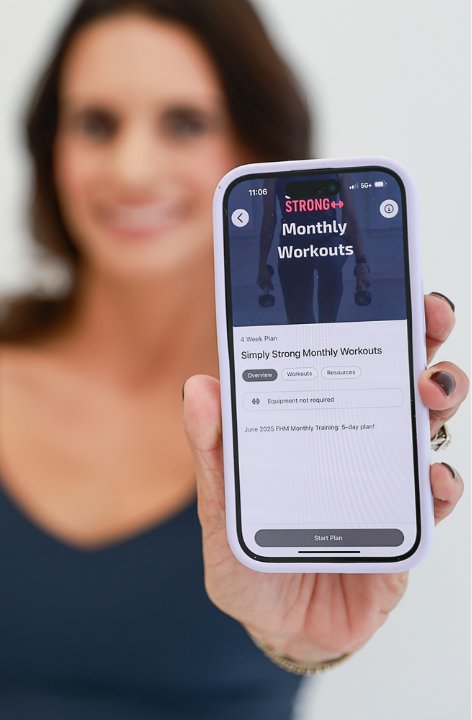
This is exactly what I do in the Simply Strong App. My monthly programs include two dedicated upper body days, split into upper body “push” (shoulders, triceps, and chest) and upper body “pull” (back and biceps). Together, these two upper body workouts will hit all of your muscles in your upper body appropriately throughout the week so you can ensure you’re getting what you need to build and sculpt your arms.
Tips for Getting Better Results From Arm Exercises
If you've been doing the same arm workout with the same light weights for months and aren't noticing much change, it's worth looking at how you're training. Here are a few ways to make the most of your upper body workouts:
1. Use Challenging Weights
Many women over 40 ask how heavy they should lift. You don't need to lift extremely heavy weights, but you do need to challenge your muscles. If you can easily perform 20 or 30 repetitions without much effort, it's probably time to increase the resistance or choose a more challenging variation.
For many exercises, a range of 8–12 repetitions is a practical place to start. The final few repetitions should feel challenging while still allowing you to maintain good form.
2. Follow Progressive Overload
Progressive overload is the process of gradually increasing the demands placed on your muscles over time.
This can mean:
- Increasing your dumbbell weight
- Performing more reps with the same weight
- Adding additional sets
- Improving your range of motion or exercise control
- Etc.
You don't need to increase your weights every single workout. The goal is to make gradual, measurable progress rather than doing the exact same routine indefinitely. Tracking your weights and repetitions makes it much easier to see whether you're getting stronger.
3. Don't Train Only Your Arms
If improving your overall body composition is one of your goals, don't limit your workouts to bicep curls and tricep extensions. A well-rounded strength training program should work your entire body, including your legs, glutes, back, chest, shoulders, and core.
Building muscle throughout your body supports strength, physical function, and long-term health. It also gives you a much more effective training routine than focusing on one body part.
4. Prioritize Protein
Protein provides the building blocks your body needs to repair and maintain muscle tissue. If you're consistently strength training, make sure you're eating enough protein throughout the day. Include a quality protein source with meals and snacks, such as chicken, fish, eggs, Greek yogurt, lean beef, or protein powder.
You don't need to rely on supplements, but adequate daily protein intake can help support your strength training and muscle-building efforts.
5. Be Consistent With Your Nutrition
If your goal includes reducing overall body fat, nutrition matters most. You cannot choose where fat loss occurs, but a sustainable nutrition approach that supports your goals can help you gradually change your overall body composition.
Avoid extreme calorie restriction, especially if you're also trying to build or maintain muscle. Focus on adequate protein, balanced meals, and an approach you can maintain long term.
How Long Does It Take to Tone Your Arms After 40?
This is one of the most common questions women have, and the honest answer is that it depends on a variety of factors, including your:
- Starting point
- Training experience
- Nutrition
- Genetics
- Overall body composition
You may begin noticing improvements in strength and exercise performance within the first several weeks of consistent training. However, visible changes in muscle definition generally take longer and vary considerably from person to person.
Instead of judging your progress only by how your arms look, pay attention to other signs that your training is working:
- You're lifting heavier dumbbells.
- You can complete more repetitions with good form.
- Push-ups and other upper-body exercises feel easier.
- You feel stronger carrying groceries, lifting objects, or doing everyday activities.
- You're noticing changes in muscle definition or how your clothes fit.
Trainer tip: Take progress photos! Progress photos are one of the best ways to view strength and muscle changes that often don’t show up on the scale.
Frequently Asked Questions
What is the best exercise for flabby arms over 40?
There isn't one single best exercise. A combination of bicep curls, tricep extensions, lateral raises, shoulder presses, and push-ups can help strengthen the muscles of your upper arms and shoulders. A balanced routine that gradually becomes more challenging will produce better results than relying on one exercise.
Can I get rid of bat wings after 40?
The term "bat wings" typically refers to loose or sagging skin and fat around the back of the upper arms. Strength training can help build the triceps and surrounding muscles, which may improve the appearance of the area. However, exercise cannot specifically burn arm fat or remove excess skin.
Should women over 40 lift heavy weights to tone their arms?
You should use weights that are challenging enough to stimulate your muscles, but they don't have to be extremely heavy. The right weight depends on the exercise and your current strength level. Focus on controlled reps, good technique, and gradually increasing resistance as you get stronger.
Are high-repetition arm workouts better for toning?
Not necessarily. Performing more repetitions with very light weights isn't automatically better for muscle development. You can build strength and muscle using different repetition ranges as long as the resistance provides an appropriate challenge and you progressively increase the demands over time.
Can I tone my arms without going to the gym?
Absolutely! Dumbbells, resistance bands, and bodyweight exercises can all be used to build upper-body strength at home. You don't need a gym membership or expensive equipment to create an effective strength training routine.
How many days a week should I do arm exercises?
Most women can incorporate direct arm exercises into two or three upper-body strength sessions per week, depending on their overall training schedule and recovery. Remember that compound movements like rows, presses, and push-ups also work your arms, so you don't need to isolate them every day.
Build Stronger Arms With a Consistent Strength Training Routine
If you're over 40 and want stronger, more defined arms, you don't need to spend hours doing arm workouts or chase every new fitness trend. Instead, focus on building muscle, challenging yourself with heavy weights, and following a strength training program that helps you continue to make progress over time.
And just because your arms might be your biggest problem area, don't forget that they’re just one piece of the puzzle. Training your entire body, eating enough protein, staying active, and giving yourself time to recover will do much more for your long-term strength and fitness than any quick-fix arm routine.
If you're looking for a structured way to get started, the Simply Strong App offers monthly strength training programs designed to help you get stronger and more toned month after month. Choose from 3-, 4-, or 5-day workout schedules, follow progressive strength workouts, and track your weights and reps right in the app as you get stronger.
Take my quick quiz to get started!