Quick Summary
Women over 40 should lift weights that challenge their muscles while allowing them to maintain good form. Learn how to choose the right dumbbell weights, determine whether you're lifting heavy enough, and use progressive overload to build strength and muscle over time.
Women over 40 have been getting a lot of pressure lately to lift heavier dumbbells, but how heavy is “heavy” Also, is it ok to do lighter weights and higher reps? Do you need to lift really heavy to build muscle? How do you know when your weights are no longer challenging enough?
To put it simply, you should be lifting weights that challenge you while allowing you to maintain good form and control. The “right” weight will depend on your current strength, the specific exercise you’re performing, your experience level, and your individual goals. There isn’t one ideal dumbbell weight for every woman over the age of 40.
It’s also not necessary to lift the heaviest possible weights to get results. The success factor that matters the most is choosing an appropriate resistance, training consistently, and gradually increasing the challenge you're placing on your muscles so you can continue to get stronger.
In this guide, I’ll share how to determine what weight to use, when you should increase it, and how to build a strength-training routine that supports your long-term health and fitness goals.
How Do You Know If You're Lifting Heavy Enough?
This is the big question that every woman over 40 wants to know: “How do I know if I’m lifting heavy enough?”
One of the easiest ways to determine whether your weights are heavy enough is to pay attention to how the last few reps in your set feel. For example, let’s say your workout calls for 10 dumbbell rows. The first several reps should feel fairly manageable, but by the final few reps, you should notice that the exercise is feeling a lot more challenging. You should still be able to complete the exercise with control, but you shouldn’t feel like you could easily do another 10 reps no problem. If that’s the case, then you’ll know you’re not lifting heavy enough.
On the other hand, if you are getting to your last few reps and you need to “swing” the dumbbells, shorten the movement significantly, or sacrifice your technique just to finish, the weight you’re lifting is too heavy, or you need to reduce the number of reps you’re doing.
A useful concept here is called reps in reserve, or RIR. It refers to how many additional repetitions you believe you could complete with good technique before maxing out. For most working sets, you should be aiming to finish with one to three good reps left in the tank. This approach is especially useful for beginners who may benefit from leaving a little more in reserve while they learn proper technique and form and become comfortable with the exercise.
There isn’t an exact science to reps in reserve; it’s more just a guidepost and a way to learn your body and what challenging effort feels like while also ensuring you’re not completely exhausted after every set.
How Much Weight Should Women Over 40 Start With?
If you're new to strength training, choosing your first set of dumbbells can feel surprisingly confusing. Walk into a sporting goods store or shop on Amazon, and you'll find everything from tiny two-pound weights to dumbbells that weigh 50 pounds or more, which is great, but can also feel overwhelming.
The good news is that you don’t need a huge collection of dumbbells and weight selections at first. A few pairs can be more than enough to start an at-home strength-training program.
For example, a woman who has never lifted weights before might find that 5 lb dumbbells are challenging for shoulder presses, while another woman who has been training for years may need 15-20 lb dumbbells in order to feel challenged. Neither is right or wrong - it’s completely dependent on the individual.
Most women can lift heavier weight for lower body exercises than upper body exercises because they involve different (larger) muscle groups and movement patterns. That being said, that doesn’t mean that every lower body exercise will warrant a heavy dumbbell; it’ll still depend on the specific exercise, your current strength level, and your familiarity with the exercise.
The best way to choose your starting weight is to test it. Begin with a manageable load, perform the prescribed repetitions, and evaluate how the set feels. If you can complete every rep with control and still have plenty left in the tank, try a slightly heavier weight. If you struggle to maintain good technique, reduce the load. And make sure you’re tracking everything so you can refer back and know exactly where to start and where you left off.
Should Women Over 40 Lift Heavy Weights or Use Lighter Weights for More Reps?
There’s so much conflicting information and opinions out there when it comes to whether women over 40 should be lifting heavy for lower reps or lighter for higher reps - and things can get pretty heated over this! The reality is that both lighter and heavier weights can help you build muscle when the resistance is sufficiently challenging and your training is structured in a way that allows you to continue making progress.
Heavier weights generally allow you to develop maximal strength more effectively, while lighter weights can also stimulate muscle growth when sets are performed with enough effort. You don't need to lift near your maximum to make progress.
For many women, a moderate weight that allows them to perform around 8–12 controlled repetitions is a practical starting point. It's easy to learn, straightforward to track, and works well for many common dumbbell exercises, while allowing for flexibility and customization.
But 8-12 reps isn’t magic; you can also build muscle utilizing higher reps. The most important component is whether or not you are finishing the set feeling appropriately challenged.
Here's how to think about it:
- Lighter weights: Useful for learning movements, building confidence, and training exercises where heavier loads aren't appropriate or practical.
- Moderate weights: A practical option for many strength-training exercises, especially when you're learning to track your progress.
- Heavier weights: Useful for developing strength when you have the technique, experience, and appropriate equipment to handle them safely.
Keep in mind that you might be utilizing a mix of these weights for a variety of exercises. You might need lighter weights for lateral raises but be able to squat with heavier weights - this is why it’s nice to have a variety of dumbbells to choose from, as every exercise can be treated uniquely.
The goal isn't to prove how much you can lift and always be maxing out; it's to choose resistance that helps you get stronger over time while maintaining proper form and technique to prevent injury.
How Heavy Should Women Over 40 Lift for Muscle and Bone Health?
For most of the women over 40 that I work with, one of the main reasons they come to me is because they are aware that maintaining their muscle and bone health as they age is increasingly important.
Muscle strength helps with everyday activities, from carrying groceries and lifting luggage to getting up from the floor. Resistance training can also help support bone health, which is an important consideration for women as we age because our risk of developing osteoporosis is quite high.
But does that mean you need to lift extremely heavy weights? Not necessarily. You simply need to provide your muscles with enough resistance to create a meaningful training stimulus. For a lot of women, this means that they are gradually increasing their dumbbell weights and reps as their strength improves. This is called progressive overload, and it's a key factor for strength and muscle results.
Progressive overload can be accomplished in a number of ways - from increasing your dumbbell weight or reps to improving your form or adding a pause or pulse to increase the time under tension. There are many ways to apply progressive overload from home with limited dumbbells, so don’t get caught up in thinking that you need to have a fully stocked home gym to see results.
For bone health, resistance training is an important part of the picture, but the benefits depend on factors such as the exercises performed, the loading used, consistency, and individual health considerations.
How to Know When It's Time to Increase Your Weights
A big mistake I see a lot of women in the over-40 crowd making is continuing to perform exercises with the same weights for months or even years without actually evaluating whether or not they’re still challenging themselves.
There’s absolutely nothing wrong with using the same dumbbells for a while - that’s completely normal! The problem arises when you continue to use that same weight simply because it’s familiar and doable.
One of the biggest mistakes I see in strength training is staying with the same weights for months or even years without evaluating whether they're still challenging.
There's nothing wrong with using the same dumbbells for a while. In fact, repeating exercises is an important part of learning proper technique and measuring progress. The problem is continuing to use a weight that no longer challenges you simply because it's familiar and comfortable. This is the point where you need to re-evaluate your strength and push yourself out of your comfort zone a bit so you can continue to see results and progress.
For example, let’s say you're performing goblet squats with a 15-pound dumbbell for three sets of 10 repetitions. At first, those sets may feel challenging, but after several weeks of consistent training, you may find that you can complete all three sets with excellent technique and could easily perform several more repetitions. This is your sign to increase the challenge you’re placing on your muscles - and you have options!
You could bump up to using a 20 lb dumbbell and work toward completing your prescribed reps with good form. This might mean that you might not be able to get 10 reps right off the bat, but it gives you something to work toward.
You don't have to increase your weights every workout or every exercise. The goal is to progress when you're ready, not to force an increase on a schedule.
A few signs that you may be ready to use heavier weights include:
- You consistently complete all your prescribed reps with good technique.
- The final repetitions no longer feel particularly challenging.
- You finish sets with more repetitions in reserve than you intended.
- You've been using the same load for a while, and your training no longer feels demanding.
If you're still struggling with technique or can't complete the prescribed repetitions, keep practicing with your current weight. Building strength is a process, and there is no benefit to rushing it.
If you don’t have a heavier dumbbell at your disposal, don’t worry; there are plenty of other ways to increase the tension on the exercise, including adding reps, adding sets, adding a pause or pulse to the hardest part of the movement, or trying a more advanced variation of the exercise.
Common Weightlifting Mistakes Women Over 40 Should Avoid
Choosing the right weight is important, but how you approach your training matters just as much. Here are a few weightlifting mistakes I commonly see women over 40 making:
Sticking with weights that are always easy. If every set feels comfortable from beginning to end, you may not be challenging your muscles enough to continue progressing.
Increasing weights before you're ready. Heavier isn't always better. If increasing the load causes you to rush, swing the weights, or lose control, return to a weight that allows you to perform the movement well first before upping the ante.
Comparing your weights with someone else's. Your friend may use 25-pound dumbbells for rows while you use 12-pound dumbbells. That doesn't automatically mean she's getting better results. Your training history, technique, and current strength are different.
Changing exercises constantly. If you never repeat an exercise, it becomes harder to determine whether you're improving. Repeating movements gives you the opportunity to practice, refine your technique, and measure your progress.
Assuming every set needs to reach failure. You don't need to push every set until you physically cannot complete another rep. Challenging sets performed with good technique can be effective without turning every workout into an all-out effort.
Thinking more is always better. Progress comes from the combination of appropriate training, consistency, and recovery. Adding more weight, more sets, or more workouts isn't automatically the answer when you're struggling to recover or stay consistent - especially for women in midlife.
How Often Should Women Over 40 Strength Train?
For most adults, general physical activity guidelines recommend muscle-strengthening activities on at least two days per week; however, I personally recommend 3-5x per week for women over 40. The number of workout days you have per week should depend on your goals, experience, schedule, and recovery. One thing is for sure: you don’t need to lift weights every day to get stronger. In fact, that approach is usually counterproductive for women over 40.
The most important thing is that you follow a structured training routine that trains your major muscle groups consistently and gives you the opportunity to track your progress and apply progressive overload.
If you're new to lifting, start with a manageable schedule and build from there. If you've been training for years, your ideal frequency may look different depending on your schedule, goals, and preferences.
The best program is one that challenges you appropriately and that you can continue following over time because it’s realistic for your life. This is why I am such a firm believer in 30-minute workouts done from home.
The Bottom Line: How Heavy Should Women Over 40 Lift?
Women over 40 should lift weights that challenge their muscles while allowing them to maintain good technique. Your age doesn't determine how much you should lift; your experience level, goals, and access to equipment will. And you don't need to use the same dumbbell weights as another woman to make progress.
Start with a weight that allows you to learn the movement and complete your prescribed repetitions with control. As the exercise becomes easier, gradually increase the challenge through heavier weights, additional reps, or another appropriate progression.
Most importantly, don't underestimate yourself by assuming you need to stick with light weights because you're over 40. All you need to do is follow a consistent plan, use enough resistance to challenge your muscles, and have a way to recognize when you're getting stronger.
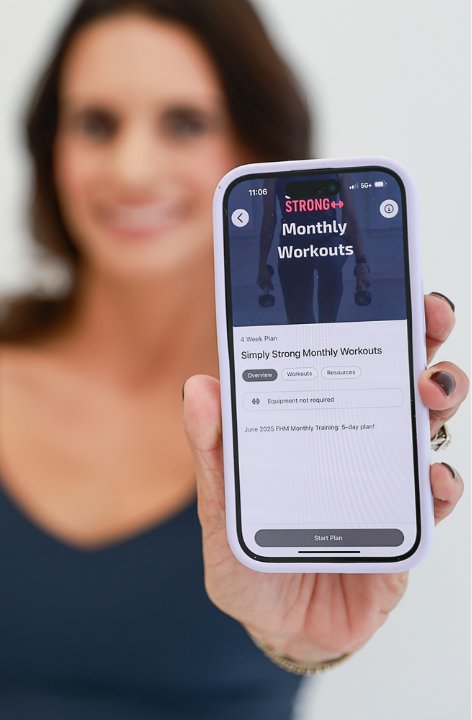
That's exactly why I believe structured strength training is so valuable. In the Simply Strong App, I program progressive dumbbell workouts for women who want to build strength without making fitness unnecessarily complicated. You can follow a 3-, 4-, or 5-day training schedule, track your weights and reps, and work toward measurable progress over time.
You don't have to guess what to do every day or constantly start over with a new workout. You can focus on showing up, practicing the movements, and getting stronger one workout at a time. Take this quiz to get started!
Frequently Asked Questions
Is 10 pounds heavy enough for a woman over 40?
It can be. Ten-pound dumbbells may be challenging for some exercises and individuals, but too light for others. The right weight depends on your current strength, the movement, and how many reps you're performing. If you can complete your sets easily and still have many reps left in the tank, consider increasing the challenge.
Should women over 40 lift heavy or do more reps?
Both approaches can be effective. Heavier weights are useful for building maximal strength, while lighter weights can also build muscle when the sets are sufficiently challenging. Many women find moderate weights and a range of roughly 8-12 repetitions practical for common strength exercises, but it’s not a hard and fast rule.
How heavy should dumbbells be for beginners over 40?
Beginners should start with weights that allow them to learn the movements and complete their reps with control. Some may start with three- to five-pound dumbbells for certain upper-body exercises, while others may comfortably use heavier weights. Start with a manageable load and adjust based on how the set feels.
Should women over 40 train to failure?
Sometimes it’s ok, but not all the time. Training to failure means reaching the point where you cannot complete another repetition with proper technique. You can build strength and muscle without doing this on every set. For many working sets, finishing with one to three good reps left is a useful and effective approach.
Can women over 40 build muscle with light weights?
Yes, lighter weights can help build muscle when you perform enough challenging reps. However, if the weights become so light that you can perform many reps without much effort, you may need to increase the resistance or otherwise make your training more challenging so that you keep making progress. At some point, most women need to bump their weights up and add to their dumbbell selection.
Is it too late to start lifting weights after 40?
Absolutely not! Women can build strength and muscle well beyond age 40. If you're new to strength training, start with manageable weights, learn proper technique, and progress gradually. Consistency and effort matter much more than how early you started. The best day to start is today! Take my quick quiz to see if training in the Simply Strong App is right for you.