

Quick Summary
Strength training shouldn't be viewed primarily as a way to burn calories or lose weight. Lifting weights helps women build and maintain muscle, improve strength, support bone health, and preserve lean mass during weight loss. Learn how often to strength train and how to combine resistance training, nutrition, and other movement for a sustainable approach to fat loss.
If you’re trying to lose weight, you might have wondered how often you should lift weights. There is all kinds of advice on the internet, and most of it contradicts itself. Should you lift two days a week? Three? Five?
Will doing more strength training burn more calories? Should you lift every day if you want to drop fat faster? This is where I want to shift the way you think about the question.
I do not want you lifting weights with the primary goal of weight loss. This might sound strange coming from a personal trainer - especially one who programs workouts for women to help them build muscle and lose body fat. But strength training has so many benefits beyond the number you see on the scale.
If your goal is to lose body fat, your nutrition plays the most integral role in creating the calorie deficit required for weight loss. Strength training is incredibly important during this process because it gives your body a reason to maintain muscle while you’re losing weight (because we do not want to lose muscle!).
And if you’re a woman in your 30s, 40s, 50s, and beyond, building and maintaining muscle should be a much bigger priority than trying to burn as many calories as possible during every workout.
So let’s talk about how often women should lift weights, what strength training actually does for your body, and why I want you to stop thinking of your dumbbells primarily as your calorie-burning tool.
Do You Need to Lift Weights to Lose Weight?
Let’s get this out of the way first: no, you do not need to lift weights to lose weight. However, that doesn’t mean you shouldn’t strength train!
Weight loss occurs when you consistently use more energy than you consume over time. The biggest driver of weight loss is nutrition - it’s the easiest and most reliable variable to control. Yes, physical activity contributes to energy expenditure, but reducing your calorie intake is a much better way to create a calorie deficit and lose weight. Regular physical activity is important for your overall health and for weight maintenance.
This is the exact reason why I don’t want you starting a strength training program with the thought process of using it to lose weight. It’ll help in a variety of ways, but it shouldn’t be your main weight loss driver. When approaching the topic of strength training, I want you to be thinking:
- How can I get stronger?
- How can I build and/or maintain my muscle mass?
- How can I improve my fitness and physical capacity?
- How will adding muscle to my frame affect my metabolism?
These are much more useful and relevant questions to ask of strength training.
So How Often Should Women Lift Weights?
For general health, the current physical guidelines recommend strength training activities involving all major muscle groups at least two times per week. However, I personally recommend women strength train 3-5 times per week. Most women over 35 find that 4 training sessions per week at around 30 minutes each is their sweet spot.
A well-designed 30-minute strength workout can be incredibly effective for building muscle, gaining strength, shaping your body, maintaining your muscles, and fueling your metabolism.
The key is that you're actually training your muscles with enough resistance and giving them opportunities to progressively adapt. This is where following a structured strength training program comes into play.
A Simple Weekly Framework
There are plenty of workout “splits” or weekly schedules you can follow depending on your goals, needs, and experience. Here are some examples of different types of training splits:
2 days: Full-body strength training
3 days: Full-body or a simple upper/lower split
4 days: Upper/lower split
5 days: A structured 5-day split if you enjoy training more frequently and can recover well
More workouts doesn’t automatically mean better or more results. Your ideal training frequency will depend on your experience, schedule, recovery, goals, and most importantly - what you can consistently maintain.
Why Building Muscle Matters More Than Burning Calories
This is the part I really want women to understand. We have been conditioned to think about exercise in terms of how many calories we can burn by doing it. We ask ourselves things like: how many calories did my watch say I burned? Did I burn enough calories to justify my workout? But what we fail to realize is that your muscles are doing much more for you than simply burning calories.
Muscle is metabolically active tissue, which means that maintaining and building muscle helps support your body’s overall energy needs. Muscle burns more calories at rest than any other type of tissue. But more importantly, having adequate muscle gives you the strength and physical capacity you need to help you stay active and mobile as you age.
Your muscles help you climb stairs, carry groceries, walk, play with your kids/grandkids, lift a suitcase, get up and down off of the floor, maintain balance, prevent falls, and perform countless other physical tasks that make up everyday life. There is a much bigger payoff for building muscle than could ever be reflected on a fitness tracker.
Strength Training Is Especially Important During Weight Loss
Here's another reason I don't want you abandoning strength training when you're trying to lose weight. When you’re trying to see the number on the scale go down, you don’t want to just lose “weight” because that can include your muscle. What you want to lose is body fat. Specifically, you want to drop body fat while preserving your lean muscle mass. Resistance training is one of the most important tools for achieving that.
I would much rather see you strength train consistently and pursue a reasonable calorie deficit than spend your entire week trying to burn as many calories as possible through cardio - only to have all the extra exertion actually drive your hunger up and make it more difficult to adhere to your deficit. When it comes to losing weight, you don’t just want to see the number on the scale go down; you want to change your body composition (lose body fat and increase muscle mass). This is achieved via a calorie deficit and consistent weight training.
Weight Loss vs. Fat Loss
These terms are often used interchangeably, but they’re not actually the same thing. Your body weight includes fat, muscle, tissue, bone, water, and organs. So if the number on the scale goes down, that doesn’t automatically mean that you lose body fat. You can lose weight while also losing muscle, which is not necessarily the outcome that you should be looking for.
Most women tell me that they want to “tone up,” which usually means they want to lose body fat and build or maintain muscle. “Tone” comes from having muscle mass on your frame and a low enough body fat percentage for it to be seen.
This is another area where strength training is incredibly valuable. When you’re training consistently and with the right stimulus, you’re sending a very strong message to your body that it needs to hold onto that muscle while your nutrition helps create the conditions for fat loss.
Does Building Muscle Make You Burn More Calories?
You’ve probably heard something like this at some point in your life: “Muscle burns tons of calories, so the more muscle you build, the faster your metabolism becomes.” And, yes, there’s some truth to that, but I think it’s been a tad exaggerated.
Muscle does require more energy to maintain, so having more muscle mass on your body does contribute to your resting energy expenditure. However, gaining muscle doesn’t suddenly turn your body into a calorie-burning machine that allows you to eat unlimited amounts of food.
That shouldn’t be the main reason why you want to build muscle. Yes, you do “burn” more calories at rest with more muscle mass, but more importantly;
- It makes you stronger.
- It supports physical function.
- It helps you maintain independence as you age.
- It contributes to a more favorable body composition.
- It supports bone health alongside appropriate weight-bearing activity.
And maintaining muscle becomes particularly important when you're intentionally losing weight. Those are all more meaningful reasons to strength train than simply trying to increase your calorie burn.
How Many Days of Strength Training Is Best for Fat Loss?
There isn't one magic number; however, I recommend 3-4x per week for best results. Three days can be the sweet spot for someone who wants to prioritize strength without spending a ton of time training. And four days can work beautifully for someone who enjoys a more structured and consistent split while still maintaining adequate recovery. Five days can be great, too, especially for those who love training and want the most consistent schedule.
I highly recommend at least 2 rest days a week from strength training, so 5 days is the most I recommend. The goal is not to do as many workouts per week as possible; it’s to find the number of workout days that feels good, gets you the results you’re looking for, and that you can maintain.
What Should Women Over 35 Focus On?
This is where my approach changes a little from the typical weight-loss conversation. As women move through their 30s, 40s, and beyond, I want to see more emphasis on muscle, strength, bone health, recovery, and long-term physical function vs. just weight loss. The scale is one measure; it is not the entire picture.
What more women need to realize is that you can be getting stronger and building body-protecting muscle while your scale weight barely changes. You can be losing inches without seeing a drop on the scale, and you can be improving your body composition while your body weight stays relatively the same. Essentially, you can become significantly healthier without becoming significantly lighter.
There’s absolutely nothing wrong with having a weight loss goal; however, the main goal for women in midlife should be to protect and care for their bodies as they age for longevity.
A Simple Strength Training Schedule for Women
If you're looking for a practical place to start, here's one example:
Monday: Lower body strength
Tuesday: Upper body push + core
Wednesday: Walking or light cardio
Thursday: Upper body pull + core
Friday: Lower body strength
Saturday: Walking or light cardio
Sunday: Rest
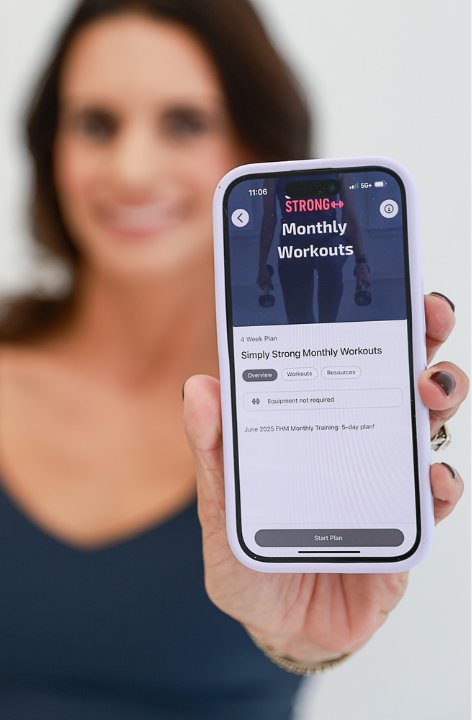
This is the exact 4-day workout split I offer inside the Simply Strong App. It’s the most popular plan I offer as it tends to be the sweet spot for many women balancing results, recovery, and sustainability.
Final Thoughts
If you're trying to lose weight, you don't need to turn strength training into a calorie-burning competition. The goal of lifting weights is to build and maintain muscle. For general health, adults should be performing some type of muscle-strengthening activity at least 2 days per week. However, many women with body composition goals benefit from 3-4 structured strength training workouts per week.
If fat loss is your goal, your nutrition will play the most critical role in creating the calorie deficit required for weight loss. Strength training complements that process by helping you preserve muscle and improve strength while you work toward your goal.
So instead of asking: "How often should I lift weights to lose weight?"
I'd encourage you to ask: "How often can I strength train consistently so I can build the strongest, healthiest body possible?"
That's a much better long-term goal, and if you take that approach, you’ll be well on your way to the body composition goals you’re seeking.
If you want to take all of the guesswork out of building a sustainable and realistic strength training routine, join me in the Simply Strong App.
Simply Strong gives you structured 3-, 4-, and 5-day strength training programs with 30- and 45-minute workout options, progressive programming, exercise swaps, workout tracking, and new training plans each month.