
Quick Summary
Wondering how many days a week you should strength train? This guide compares 3-day, 4-day, and 5-day workout splits, explaining the benefits of each and helping you choose the schedule that best fits your goals, experience level, and lifestyle.
By far, one of the most common questions women ask before starting a strength training program is: “How many days a week should I work out?”
Should you strength train three days a week? Is four days better? Will you see faster results if you lift five days a week? Honestly, there is no such thing as a “best” workout split; it’s really just the one that fits your schedule and that you can realistically maintain.
For most who are trying to figure out how often women should strength train, the answer is going to either be 3,4, or 5 days per week. More days doesn’t necessarily mean better results, but there are pros and cons to each training split, which we’ll explore in this article.
Is More Always Better?
No, not when it comes to strength training and definitely not when it comes to women over 35. Unfortunately, we often assume that more is better, but the truth is that your progress depends a lot more on the following factors:
- Following a structured program
- Training consistently
- Applying progressive overload
- Prioritizing recovery
- Eating enough protein
A five-day program isn't "better" if you can only realistically complete three workouts each week. And a 3-day approach isn’t going to be great if you aren’t following a program that’s designed for results.
This is why following a structured plan matters more than simply working out more often. If you've ever wondered why repeating similar workouts is actually beneficial, read Why Repeating Workouts Is How You Get Results.
3-Day Strength Training Split
A three-day workout split is one of the best options for beginners and busy women with limited time. This split provides enough training volume to build strength while also leaving plenty of recovery time between workouts as well as the freedom to explore other fitness modalities throughout the week.
Example Weekly Workout
- Day 1: Lower Body
- Day 2: Upper Push + Core
- Day 3: Upper Pull
Or
3 full-body workouts per week
Best For
- Beginners
- Busy schedules
- Moms
- Women returning to exercise
- Anyone who wants a sustainable routine
Benefits
- Easy to stay consistent
- Plenty of recovery
- Less overwhelming
- Excellent for building strength
4-Day Strength Training Split
A 4-day training program increases your weekly training volume while still providing adequate recovery time. This approach allows you to train lower body twice per week, which is a common desire for women.
Example Weekly Workout
- Day 1: Lower Body I
- Day 2: Upper Push + Core
- Day 3: Lower Body II
- Day 4: Upper Pull
If you'd like to see this type of program in action, check out our 4-Day Dumbbell Workout for Women, which follows a similar structure using minimal equipment at home.
Best For
- Intermediate lifters
- Women ready for more training volume
- Those wanting extra lower-body focus
- Women with four available workout days most weeks
Benefits
- Balanced weekly volume
- Two lower-body sessions
- Easy to recover from
- Supports muscle growth and strength
5-Day Strength Training Split
A five-day split offers the highest training frequency of the three options, but instead of simply adding more work for the sake of doing more, it creates space for a full-body conditioning workout that complements your strength training and adds a different stimulus to your week.
Example Split
- Day 1: Lower Body I
- Day 2: Upper Push + Core
- Day 3: Full-Body Conditioning
- Day 4: Upper Pull
- Day 5: Lower Body II
This is the same weekly structure we use in our 5-Day At-Home Dumbbell Workout for Women, combining progressive strength training with one dedicated conditioning workout that offers higher reps, lighter weights, and an opportunity to get your heart rate up.
The conditioning day helps to improve cardiovascular fitness, work capacity, and overall conditioning while still incorporating resistance training.
Best For
- Experienced lifters
- Women who enjoy working out most weekdays (routine)
- Those looking to improve both strength and conditioning
- Women who recover well between sessions
Benefits
- Highest weekly training volume
- Dedicated conditioning workout
- Well-rounded fitness
- Plenty of opportunities to practice movement patterns
Which Split Builds the Most Muscle?
If weekly training volume and effort are similar, research suggests that all 3 options can effectively build muscle. The biggest difference isn’t in the number of days, but rather whether or not you’re able to:
- Train consistently
- Progress over time (progressive overload)
- Recover well
- Stay committed long enough to see results
A perfectly designed five-day plan won't outperform a three-day plan that you actually show up and complete every week.
Following the principles of progressive overload is ultimately far more important than choosing a specific workout split. If you’re working hard in your sets, incrementally adding load, and showing up consistently, you’ll be sending the right signal to your body to build muscle.
How to Choose the Right Workout Split
Now, here’s the hard part: determining which workout split is best for you. To help you figure this out, I recommend asking yourself these questions:
How many days can I realistically commit to?
It’s important to choose the schedule that you’ll be able to stick to long-term (think 6 months or more in the future) - not the one that seems flashy now.
How much recovery do I need?
Recovery becomes increasingly important as training volume increases and as we age. If you're consistently sore, exhausted, or missing workouts, you may actually benefit from training fewer days with greater consistency.
What's your primary goal?
- General fitness: 3 days
- Building strength: 3–4 days
- Building muscle: 4–5 days
- Strength plus conditioning: 5 days
Remember, these are general guidelines, not rules. Regardless of your goals, you can train 3,4, or 5 days per week.
Which Split Does the Simply Strong App Use?
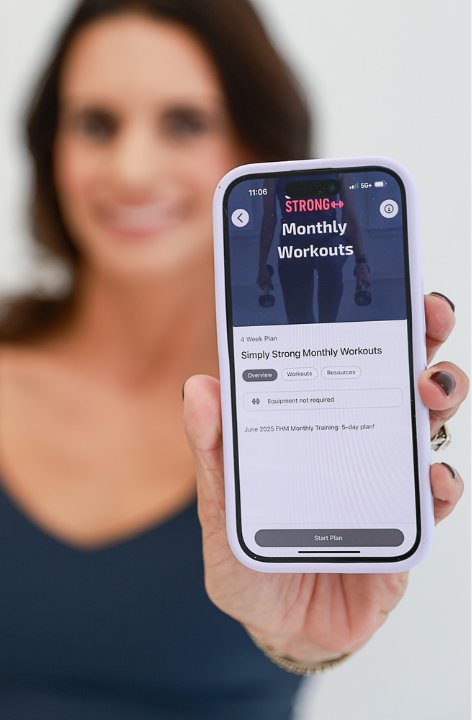
One of the things that makes the Simply Strong App unique is that members don't have to choose between one "perfect" workout split; we include all three options to choose from each month.
Each month includes programming for:
- 3-day split: Lower Body, Upper Push + Core, Upper Pull OR 3-day full body
- 4-day split: Lower Body I, Upper Push + Core, Lower Body II, Upper Pull
- 5-day split: Lower Body I, Upper Push + Core, Full-Body Conditioning, Lower Body II, Upper Pull
Each option follows the same training philosophy, emphasizing progressive overload, balanced muscle group training, and sustainable strength gains.
The workouts are intentionally repeated throughout the month so members can track their weights, improve their technique, and continue progressing. If you've ever wondered why repeating workouts is necessary, read Why Random Workouts Kill Progress.
What this means for you is that you can choose the workout schedule that works best for your lifestyle and goals without sacrificing results.
Final Thoughts on Training Splits
There’s no such thing as a perfect workout split; it’s just the one that you can stick with consistently and that you won’t feel burnt out or rundown from. Whether you choose a 3,4, or 5-day program, the biggest key to getting results is following a structured plan.
Take our quick, 2-minute quiz to see if you’re ready to train in the Simply Strong App.