
Quick Summary
This 4-week workout plan for women uses the same structured workouts each week so you can focus on improving your strength instead of constantly chasing new workouts. You'll repeat the program for four weeks, track your weights and reps, and gradually increase the challenge through progressive overload. After four weeks, move into a new training block that builds on your progress rather than starting over.
If you’re looking for a 4-week workout plan for women, you’ll find plenty of programs online that’ll give you a completely different workout every day. However, that’s not what I’m going to recommend for you.
If you’re coming into this with the goal of getting stronger, building muscle, improving your fitness, and actually seeing progress from your workouts, then I want you to spend the next four weeks following the same structured program. Why? Because consistency is what creates change. Consistency helps you learn the movements, track your progress, and progressively challenge yourself in each exercise.
That’s exactly what the 4-week workout plan I am going to share with you in this article is designed to do. I’m going to share the complete 4-week program with you so you can follow it for four weeks. I’ll also explain how I recommend approaching those four weeks so you’re not just checking workouts off your calendar.
Why I Recommend Four Weeks of the Same Program
One of the biggest mistakes I see women make with strength training is changing their workouts too often. While a new workout every day can be fun and feel exciting, it makes it really difficult to know whether you’re actually improving. In fact, random workouts can actually kill your confidence.
A 4-week training block that has you repeating the same exercises with the intention to get stronger is key for reliable results. You get repeated exposure to the same movements, giving you the opportunity to become more comfortable with the exercises. You’ll track your weights and reps, and most importantly - you’ll have several opportunities to progressively challenge yourself, which is how strength is built.
What Is Progressive Overload?
Progressive overload simply means gradually increasing the challenge you're giving your body over time. This doesn’t mean increasing your weights every time you do an exercise; there are so many different ways to make progress, including:
- Increasing the weight
- Performing more reps with the same weight
- Improving your form
- Increasing your range of motion
- Slowing down the movement and improving control
- Adding a pulse or pause at the hardest part of the movement
- Using a more challenging variation
For traditional strength training, increasing resistance is one of the most straightforward ways to progressively overload. For example, let's say you start this program doing 10 goblet squats with a 25-pound dumbbell. The next week, you might be able to complete 11 or 12 reps with the same weight. Eventually, you may be ready to pick up a 30-pound dumbbell for some reps.
That's progress, and because you're repeating the movement, you can actually see it because you’ll have tracked it over time.
Your 4-Week Workout Plan
This plan uses four strength training days per week. It’s set up so that you’ll be repeating the same four workouts each week for four weeks. The goal over the course of the program is to find opportunities to improve and increase while maintaining good form and recovering well between sessions.
Here’s the weekly schedule:
Monday: Lower Body
Tuesday: Upper Body Push + Core
Wednesday: Rest or easy movement
Thursday: Upper Body Pull + Core
Friday: Lower Body
Saturday: Optional walking, cardio, or mobility
Sunday: Rest
You can move these days around to fit your schedule. The important thing is to give your muscles adequate recovery; i.e., don’t schedule your two leg days back-to-back - allow at least a couple of days in between them.
Here’s an overview of the workouts, but there will be a downloadable/printable PDF at the end.
Workout 1: Lower Body
Goblet Squat
3 sets x 8-12 reps
Romanian Deadlift
3 sets x 8-12 reps
Reverse Lunge
3 sets x 8-10 reps per side
Glute Bridge
3 sets x 10-15 reps
Banded Lateral Walk
2 sets x 12-16 reps, alternating
Workout 2: Upper Body Push + Core
Dumbbell Chest Press
3 sets x 8-12 reps
Dumbbell Shoulder Press
3 sets x 8-12 reps
Dumbbell Lateral Raise
3 sets x 8-10 reps
Overhead Triceps Extension
3 sets x 10-12 reps
Dead Bug
3 sets x 12-16 reps, alternating
Workout 3: Upper Body Pull + Core
Single-Arm Dumbbell Row
3 sets x 8-10 reps each arm
Dumbbell Rear Delt Fly
3 sets x 8-10 reps
Dumbbell Biceps Curl
3 sets x 10-12 reps
Dumbbell Pullover
3 sets x 8-10 reps
Bird Dog
3 sets x 12-16 reps, alternating
Workout 4: Lower Body
Dumbbell Reverse Lunges
3 sets x 8-10 reps each leg
B-Stance Goblet Squat
3 sets x 8-10 reps each leg
Dumbbell Hip Thrust
3 sets x 10-12 reps
Dumbbell Step-Ups
3 sets x 8-10 reps each leg
Wall Sits
3 sets x 30 seconds each
How to Progress Through the Four Weeks
Here's where I want you to approach this plan differently than a typical online workout calendar; I don’t want you to just go through the motions and repeat these workouts. I want you to track them.
To get started, choose weights that allow you to complete the prescribed reps with good form while still making the final few reps feel challenging.
Don't just repeat the workouts. Track them.
Before you start, choose dumbbells that allow you to complete the prescribed reps with good form while still making the final few reps challenging. Then record what you do. For example:
Goblet Squat
Week 1: 25 lbs × 10 reps
Week 2: 25 lbs × 12 reps
Week 3: 30 lbs × 10 reps
Week 4: 30 lbs × 12 reps
That's progressive overload. You got stronger each week either by increasing the number of reps you did or by increasing the weight you lifted.
What If You Can't Increase the Weight?
You don't necessarily have access to a heavier dumbbell every week, especially if you're training at home. If you're working with the same equipment at home, look for other ways to make progress. You can:
- Improve your form
- Slow down your tempo
- Add a pause or a pulse
- Add an extra set
There’s no “right” or “wrong” way to do it; the goal is simply to approach the workout with the intention of looking for potential places to make progress.
What Should You Do After the Four Weeks?
This is where I think a lot of workout plans fall short. You get a four-week workout program, get through it, and then have no idea what to do next. Suddenly, you’re back to scrolling the internet/social media for another plan. That’s not how I recommend approaching strength training.
Four weeks should be a training block, not the end of your training. After four weeks, you should move into a new program that builds on the work you've already done. You don't necessarily need to throw everything away and start from scratch. In fact, you shouldn’t.
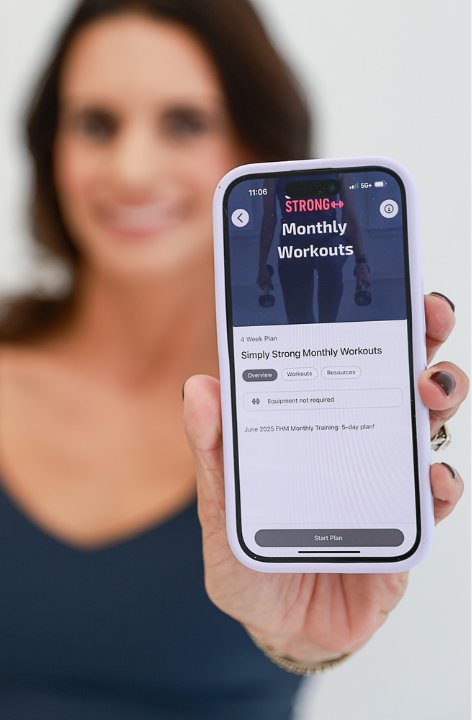
Your next training block can introduce new exercises, different rep ranges, new challenges, or slightly different training variables while continuing to build strength. That's the approach I use in the Simply Strong App.
How the Simply Strong Approach Works
Simply Strong is built around progressive overload, and we do it in structured monthly workout programs. You follow the program consistently over the course of 4-5 weeks, repeating exercises, tracking your progress, and looking for opportunities to apply progressive overload so that you can get stronger.
Then, when the next month begins, you get a new program to follow that builds on the previous month’s program. This is how you get the best of both worlds. You get enough repetition to actually improve, but you also get enough variety over time to keep your training fresh and exciting. But you're building from one training block into the next, not just doing random workouts.
And because the workouts are already programmed for you, you don't have to waste time trying to figure out what to do - you just open the app and follow the plan.
What You Get With Simply Strong
The workout plan above gives you a starting point, and it’s similar to what you would see in the Simply Strong App’s monthly workout programs. But the biggest benefit of following a structured program isn't simply having a list of exercises to do; it’s having the entire process taken care of for you.
With your Simply Strong App monthly membership, you get:
- New progressive programming every month
- 3-, 4-, and 5-day workout options
- 30- and 45-minute daily workout options
- Dumbbell and band-based training (all at-home friendly)
- Exercise demonstrations and form guidance
- Exercise swaps when something doesn't work for you
- Workout tracking so you can see your progress
- Structured progression rather than random workouts
- Core work built into your training
- A private community
- A growing library of resources and recipes (over 500 recipes!)
The goal is to make strength training simpler, not more complicated. I take care of all the details for you so that all you need to do is show up and follow the plan.
Download the Free 4-Week Workout Plan
If you want to take this plan with you, I've created a downloadable PDF version so you can save it to your phone or print it out and keep track of your workouts. Follow this plan for the full four weeks, track your weights and reps, be on the lookout for small improvements, and don’t stress over being perfect.
If you find that you enjoy this 4-week workout plan and want to have something similar programmed for you every month inside a comprehensive app experience, join my monthly membership in the Simply Strong App so you can keep your progress going. Your next training block is already waiting for you in the app!