
If you’ve ever looked at a workout or listened to someone on Instagram talk about sets, reps, splits, rest…and thought, “wait…what does that even mean??” - you’re not alone. Unless you’ve been in the fitness industry or have been training for a while, it’s quite common to not immediately understand these terms.
For a lot of women, especially when starting a strength training routine at home, the terminology can feel overwhelming and confusing to the point where they’re unsure if they can even complete the workout - but we don’t want that! The truth is, there are a few simple definitions that, once you understand, everything will start to click.
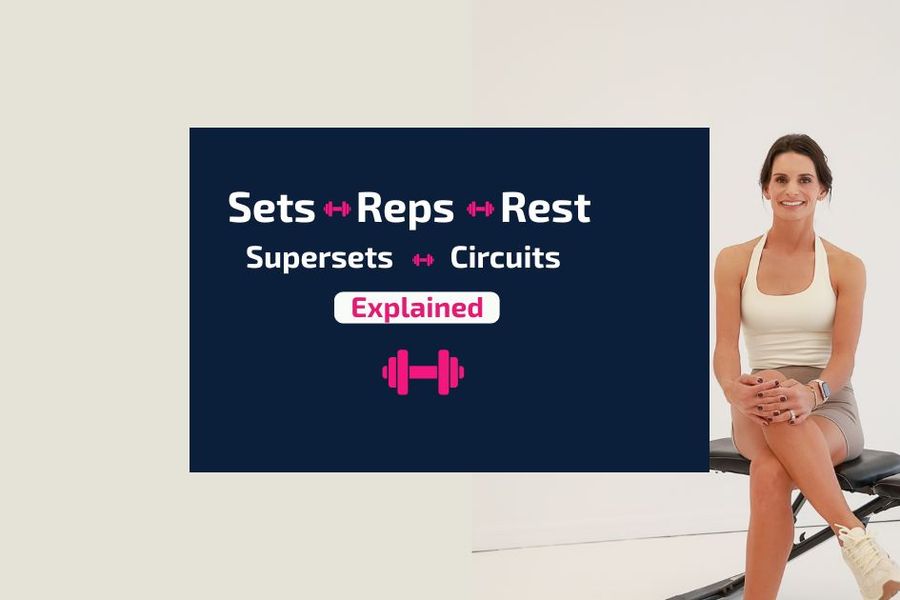
Sets, reps, splits, rests, supersets, circuits - these aren’t just random words; they’re how your workouts are structured to help you build strength and reach your goals, so let’s get to know them.
What Are Reps?
Reps is short for repetitions, which are the number of times you perform a single exercise.
For example, if you see an instruction to do 10 reps of squats, that means you will be doing 10 squats in a row. Each rep is one complete movement - lowering into the squat and then standing back up counts as one “rep.” This same concept applies to all exercises like rows, presses, lunges, etc.
Understanding reps is important because they help you to determine how long your muscles are working during a set. You’ll see rep ranges anywhere from 8 to 15 reps for most strength exercises.
What Are Sets?
A set is a group of reps that are performed in a row before you take a break. So if your workout instructs you to do “3 sets of 10 reps,” that means you’ll be doing this:
- 10 reps
- Rest
- Repeat two more times for a total of 3 sets of the same exercise
The number of sets you do allows you to accumulate enough work to actually challenge your muscles. If you only did one set of an exercise, it’s usually not enough on its own to create meaningful strength changes. However, when you add multiple sets to the workout, it builds the stimulus your body needs to adapt.
Why Rep Ranges Matter
Sometimes you’ll see rep ranges listed for an exercise instead of a fixed number, like 8-12. Or, you’ll be encouraged to work within a certain rep range. This is intentional and key to making progress.
Having a rep range gives you the flexibility to make the workout your own while still guiding your progress. Early on in an exercise, you might only be able to complete 8 reps with good form, but over time, you might work your way up to 12 reps.
Once you consistently hit the top of your rep range, it’s usually a clear sign that you’re ready to make the exercise more challenging - either by increasing your weight or adjusting another variable (tempo, time under tension, etc.).
What Are Single Sets?
Single sets involve completing all of the sets of one exercise before moving on to the next exercise.
For example, if you have 3 sets of shoulder presses, you’ll do set one, rest, do set two, rest, do set three, rest, and then move onto the next exercise in the workout.
Single sets are the best way to prioritize strength and intention within the most important lifts of your workout.
What Are Supersets?
Supersets involve performing two exercises back-to-back before resting.
For example, you might have lunges followed immediately by bicep curls. You would do the number of prescribed reps for each exercise back-to-back (no resting in between exercises) and then rest, and then repeat for the total number of sets.
Supersets are often used to make workouts more time-efficient while still building strength. These are also a good way to get your heart rate up a bit and challenge your body in a new way.
What Are Circuits?
Circuits involve performing several exercises in a row with little to no rest in between, and then resting after completing the full round.
For example, you might have a circuit with squats, rows, lunges, and presses that you will perform back-to-back before taking a break. Once your rest time is up, you’ll repeat the entire sequence again for the prescribed number of sets.
Circuits make workouts feel faster-paced and are often used to improve overall conditioning, as your heart rate will remain elevated during the circuit. However, these are used very infrequently in progressive overload programming as they are not the best way to build muscle.
What About Rest?
Rest is the time you take between sets, where you aren’t doing any work; you’re quite literally resting. This is where a lot of women either rush or just skip entirely, especially if they are used to fast-paced or cardio-style workouts. But rest plays a critical role in effective strength training.
When you rest, your muscles recover enough to perform the next set with good form and max effort. Without adequate rest, each set becomes less effective because you’re too fatigued to actually put forth the effort required to challenge your muscles.
For most strength training workouts at home, resting for a minimum of 60 seconds between sets works well.
Why This Matters in Midlife
In midlife, structure matters more than intensity. Your body responds best to workouts that are consistent, repeatable, and progressively challenging. Understanding sets, reps, rests, and different workout formats allows you to train with intention and in alignment with your goals.
If your goal is to build muscle, look more toned, and protect your body as you age, you shouldn’t be constantly switching workouts or following a structure that doesn’t allow for adequate rest between sets. Instead, you should be focusing on plans with moderate to low rep ranges (8-12), mostly single-set exercises, scheduled rest times, and a plan for progressive overload over time. This is the kind of structure that supports real progress, not just sweat.
Do this simple workout: Try my 30 minute (dumbbell only) full body strength workout for perimenopause
Keep It Simple
You don’t need complicated routines to get stronger. You just need a solid understanding of the basics:
- How many reps you’re doing
- How many sets you’re completing
- How much rest you’re taking
- And how your workout is structured
When you understand these concepts, and you choose a plan that aligns with your goals, everything else becomes clearer, and your workouts start to become more effective.
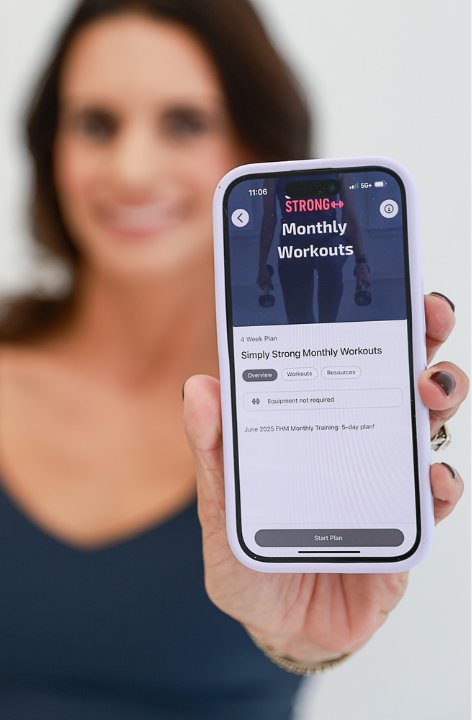
If you’re looking for a progressive strength training program built for women over 35 to get stronger, leaner, and more confident, most effectively and efficiently, I invite you to give the Simply Strong App a try.