
Quick Summary
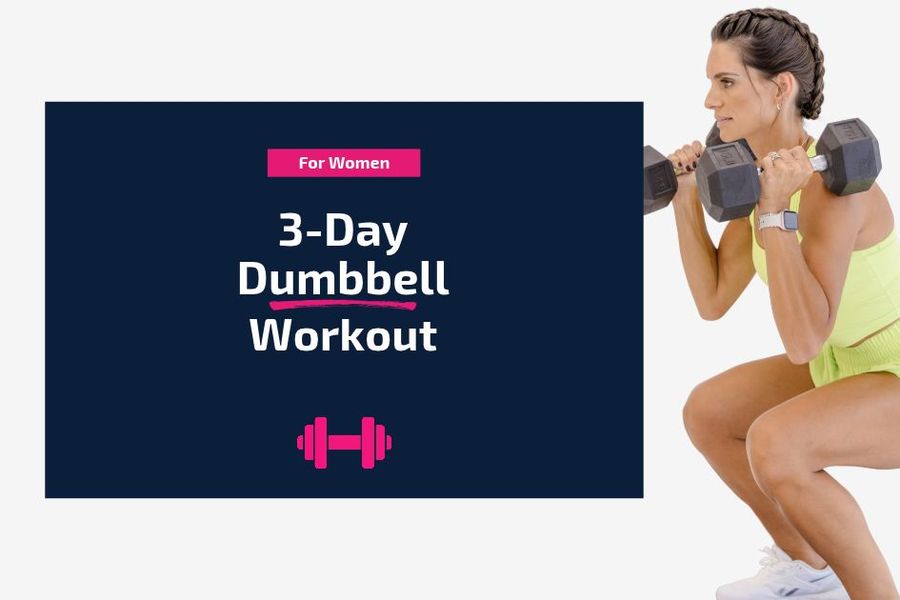
This 3-day dumbbell workout for women is a simple at-home strength training routine designed to help you build muscle and get stronger without spending hours working out. The plan includes lower body, upper push, and upper pull workouts with core training, plus guidance on progressive overload and choosing the right dumbbell weights.
For many women, 3 strength training sessions per week is very sustainable. A well-designed three-day strength training routine will provide you with plenty of training volume to help you build muscle, get stronger, and enjoy a workout routine that you can actually stick with. If you’re working out from home, a couple of pairs of dumbbells are all you really need to get started.
This 3-day dumbbell workout uses a standard lower body, upper push, and upper pull split with core training built in. Each workout is designed to take you 30-45 minutes. The goal of this training approach is to get stronger over time and develop a lifting routine that you can stick with.
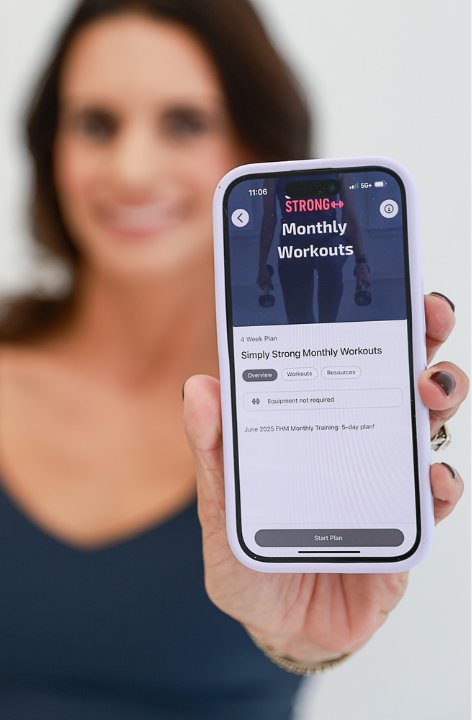
This is the exact approach we take for our monthly 3-day strength training plan inside the Simply Strong App. In this article, I’m going to share an example of a 3-day training program that requires only dumbbells.
The 3-Day Dumbbell Workout at a Glance
This program is split into three focused strength workouts each week:
Day 1: Lower Body
Day 2: Upper Push + Core
Day 3: Upper Pull + Core
You can arrange the workouts around your schedule, but I'd recommend putting at least one rest or lower-intensity day between strength sessions, if possible.
For example, you could choose to train Monday, Wednesday, and Friday, with walking or rest days in between. The exact days don't matter nearly as much as finding a schedule you can consistently follow, and that works well for your routine.
Day 1: Lower Body Dumbbell Workout
The first workout of the week focuses on your major lower-body muscle groups, including your glutes, quads, and hamstrings. Here’s what to do:
Dumbbell Goblet Squat
3 sets of 8-12 reps
Hold one dumbbell vertically at your chest and lower into a squat with control. Keep your core braced as you drive through your feet to return to standing.
Choose a weight that makes the last few reps challenging while allowing you to maintain good form.
Dumbbell Romanian Deadlift (RDL)
3 sets of 8-12 reps
Hold a dumbbell in each hand and hinge at your hips, lowering the weights toward your legs while keeping your back neutral.
Think about pushing your hips backward rather than simply lowering the dumbbells toward the floor. You should feel this primarily through your hamstrings and glutes.
Reverse Lunge
3 sets of 8-10 reps per leg
Step one foot backward and lower into a lunge before driving through your front foot to return to standing.
You can hold dumbbells at your sides or perform this exercise with bodyweight if you're newer to strength training.
If balance is a challenge, use a wall or other sturdy surface for support.
Dumbbell Glute Bridge
3 sets of 10-15 reps
Place one dumbbell across your hips and drive through your feet to lift your hips toward the ceiling. Pause briefly at the top and squeeze your glutes before lowering with control.
Focus on using your glutes to create the movement rather than arching your lower back.
Standing Calf Raise
3 sets of 12-15 reps
Hold dumbbells at your sides and slowly rise onto the balls of your feet. Lower your heels with control and repeat.
Day 2: Upper Push + Core
The second workout focuses on your upper-body pushing muscles, which include your chest, shoulders, and triceps, followed by core work.
Dumbbell Chest Press
3 sets of 8-12 reps
Lie on your back with a dumbbell in each hand. Lower the weights toward the floor with control, then press them back up.
The floor provides a natural stopping point for your elbows, making this a great at-home pressing exercise.
Dumbbell Shoulder Press
3 sets of 8-12 reps
Start with the dumbbells around shoulder height and press them overhead. Keep your core engaged and avoid using momentum to move the weights.
If overhead pressing doesn't feel good for your shoulders, choose a different pressing variation that works better for your body.
Dumbbell Lateral Raise
3 sets of 10-12 reps
Hold lighter dumbbells at your sides and raise your arms out toward shoulder height. Keep the movement controlled and avoid swinging the weights.
You don't need heavy dumbbells for this exercise. In fact, using a lighter weight and focusing on control is often much more effective.
Dumbbell Overhead Triceps Extension
3 sets of 10-12 reps
Hold one dumbbell with both hands and lower it behind your head before extending your arms to return to the starting position.
Keep your elbows relatively close together throughout the movement and focus on moving through your elbows rather than using momentum.
Dead Bug
3 sets of 8-10 reps per side
Lie on your back with your arms extended toward the ceiling and your knees bent. Slowly lower the opposite arm and leg while keeping your core engaged and your lower back controlled.
Move slowly and focus on maintaining control rather than trying to extend your limbs as far as possible.
Day 3: Upper Pull + Core
The final workout focuses on your upper-body pulling muscles, which include your back and biceps, with additional core work at the end.
Single-Arm Dumbbell Row
3 sets of 8-10 reps per side
Support yourself with one hand on a bench or sturdy surface and row the dumbbell toward your hip.
Keep your shoulders square and avoid twisting your torso as you pull.
Think about driving your elbow toward your back pocket.
Dumbbell Bent-Over Row
3 sets of 8-12 reps
Hold a dumbbell in each hand and hinge forward at the hips. Pull both dumbbells toward your body, squeezing your shoulder blades together before lowering them with control.
Keep your core engaged and maintain a strong, neutral back throughout the movement.
Dumbbell Rear Delt Fly
3 sets of 10-12 reps
Hinge forward and raise the dumbbells out to the sides. Use lighter weights and focus on controlled movement rather than trying to lift as much weight as possible.
Dumbbell Hammer Curl
3 sets of 10-12 reps
Hold the dumbbells with your palms facing toward each other. Curl the weights toward your shoulders while keeping your elbows close to your sides.
Lower the weights slowly rather than allowing them to drop.
Bird Dogs
3 sets of 8-10 reps per side
Start on your hands and knees. Extend one arm and the opposite leg while keeping your torso stable. Return to the starting position and switch sides.
Think about keeping your body as still as possible while your arm and leg move.
How to Make This 3-Day Dumbbell Workout Work
Showing up and doing this 3-day dumbbell workout plan once is great, but that’s just the beginning. If you want to build real muscle and strength, you’ll need to give your body a reason to adapt. This is where progressive overload comes in.
Progressive overload simply means gradually increasing the challenge placed on your muscles over time, but that doesn't mean you need to add weight every single workout. There are lots of other ways to make small improvements, including:
- Adding reps
- Adding sets
- Improving your form
- Adding a pause or pulse
The goal isn’t necessarily to make every workout harder; it’s to become stronger over time. And, yes, this means that you’ll need to repeat the same workouts/exercises so that you can work on improving them.
How Heavy Should Your Dumbbells Be?
This is a topic that some women get really caught up in. Choosing your dumbbells isn’t as complicated as you might think. Your goal should be to choose a weight that makes the final few reps feel challenging while still allowing you to maintain good form.
For most exercises, you should finish your set feeling like you could have a good 1-3 reps left in the tank. If you finish the set feeling like you could easily complete several more reps, your weight is probably too light. If you’re struggling to maintain good form before you reach your target reps, you’re probably going too heavy.
And keep in mind that you’ll likely be using different weights for different exercises. The dumbbells that you choose for squats are going to be heavier than the dumbbells that you use for lateral raises. This is completely normal and why I recommend having at least a few pairs of different-sized dumbbell weights.
How Many Days a Week Should Women Strength Train?
The question of how many days women should train is a common one as well. Generally speaking, I recommend 3-5 strength training days per week, with 3 days being an excellent routine for women who want to build muscle and get stronger without working out every day.
Three focused strength sessions leave plenty of room for other forms of exercise/movement, including walking/running, mobility work, hiking, dancing, etc. A lot of women like to do their 3 strength-focused sessions and then fill in their remaining days with walking and recovery. You really don’t need to work out 6 days a week to make progress, especially if you’re a woman over 35.
A routine you can consistently follow will always beat a "perfect" routine you can't maintain.
Ready for a Strength Training Plan That Does the Thinking for You?
The free workout outlined in this article gives you three solid strength training workouts to get started with. But one of the most important things that you need to know if you want to actually get results is that you’ll need to be following a program that takes care of the progressions for you.
Anyone can follow a free workout plan for a week, or even a month, but what do you do next? The thing you don’t want to do is jump around from one program to the next and never get into the habit and routine of training with a specific program consistently. This is where so many women end up spinning their wheels and missing out on so much progress.
This is exactly what the Simply Strong App is designed to help you avoid. Inside the Simply Strong App, you’ll get structured strength training programs that build on each other month after month. Instead of searching for a new workout routine every time you go to work out, you’ll open the app and know exactly what to do for the day. We take all of the guesswork out of it for you.
You can choose from 3-, 4-, or 5-day programs with 30- or 45-minute workouts. You’ll track your weights and reps and be able to see your workout history so you know exactly how and when you’re making progress. You’ll also have access to a real personal trainer (me!) should you have any questions, and a community of women who are working toward the same goal.
You don't need more random workouts; you need a plan you can follow and progress with. Take our quick quiz to see if Simply Strong is the right fit for you and your goals.