
Quick Summary
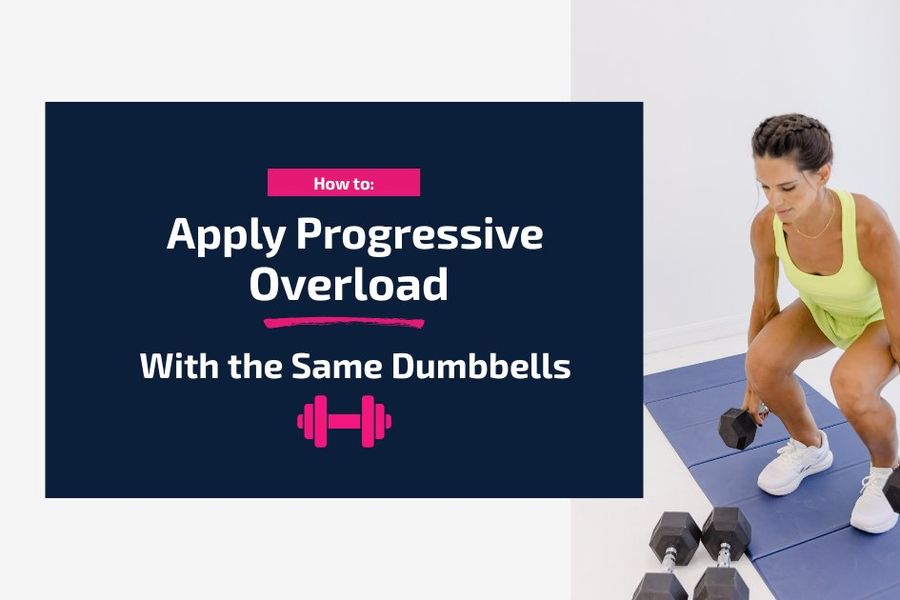
Working out from home and only have access to a couple of pairs of dumbbells? You can still apply progressive overload and make progress without buying more dumbbells; here's how.
One of the biggest misconceptions about strength training from home is that you need to keep buying heavier dumbbells in order to get stronger and to continue to see results. While yes, increasing weight is one form of progressive overload, it’s far from the only way to accomplish it.
In fact, many women make phenomenal progress using a limited amount of dumbbell weights. If you work out at home and only have the budget or space for a few pairs of weights, don’t assume you’re going to stall progress - there are several ways to make your workouts more challenging without spending money on additional equipment.
Here's how to continue progressing your workouts at home with the same dumbbells.
What Is Progressive Overload?
Progressive overload is one of the most important concepts in strength training; it’s the process of gradually increasing the challenge placed on your muscles over time. As your body adapts to a workout, it becomes more efficient at doing it. In order to continue building strength and muscle, you need to provide it with a new challenge or stimulus.
The new challenge doesn’t always need to mean lifting heavier weights; it can come from increasing reps or sets, improving your technique, slowing down your tempo, or choosing a more challenging exercise variation.
At the end of the day, the goal is very simple: you need to continue to ask your muscles to do a little more than they did before to keep strengthening and growing.
P.s. If before you read this, if you’re newer to strength training and aren’t familiar with all of the terms, this article will help explain it.
1. Increase Your Reps
One of the easiest ways to progress is by performing more repetitions with the same weight.
For example:
- Week 1: 8 reps
- Week 2: 10 reps
- Week 3: 12 reps
Once you can comfortably perform the top end of your rep range with good form, you may be ready to increase the weight if you have heavier dumbbells available. For women seeking muscle growth and hypertrophy, I don’t recommend going past 12-15 reps - once you hit that point, it’s time to apply another form of progression.
2. Add Another Set
If your workout calls for three sets and you’ve reached the point where you can easily get through your sets with some gas in the tank, you can consider adding an additional set to your program.
This approach increases your overall training volume, giving your muscles more work to do without the need to add a heavier dumbbell.
3. Slow Down Your Tempo
When you slow down your reps and move with more intentionality, you’re increasing the time your muscles spend under tension, which is yet another form of progression. For example, instead of lowering into your squat quickly, you can focus on lowering for 3 seconds before standing back up and getting into the next rep.
Another way to do this would be to add a pause at the most challenging part of the movement before returning to the starting position. So for a squat, for example, pause at the bottom of the squat for 3 seconds before standing back up.
4. Add a Pause
Speaking of pausing, that’s our next form of progressive overload - adding one helps remove any momentum and forces your muscles to do more of the work.
Examples include:
- Holding the bottom of a squat for two to three seconds
- Pausing just above the floor during a push-up
- Holding the top of a glute bridge before lowering
Small changes like these can make familiar exercises feel so much more challenging.
5. Progress to a More Challenging Variation
Without getting heavier dumbbells, you can progress from a basic variation of an exercise to a more complex or advanced one to keep your progress going. Here are some examples:
- Glute bridge to single-leg glute bridge
- Goblet squat to goblet squat with a pulse at the bottom
- Reverse lunge to a deficit (standing on a slight elevation) reverse lunge
- Shoulder press to 1 ½ rep shoulder press (adding in a half rep)
- Bent over row to single-arm bent over row with a slow eccentric (lowering phase)
This is one of the most effective ways to continue making workout progress from home, and this is where having an efficiently designed program will really shine.
6. Improve Your Range of Motion
Focusing on creating a larger range of motion often makes an exercise more challenging while helping improve mobility and strength. Some examples of this include:
- Squatting deeper with control
- Performing deficit lunges
- Increasing the stretch during Romanian deadlifts while maintaining a neutral spine
But remember: quality always comes before depth; you’ll need to make sure you’ve mastered the basics of the exercise and your form before trying for an increased range of motion.
7. Improve Your Technique
Not all progress is measured by heavier weights and more reps; sometimes it comes in the form of:
- Better control
- Better balance
- Improved posture
- Greater stability
- A stronger mind-muscle connection
These improvements often lead to better long-term strength gains because there’s an additional level of intentionality with every exercise.
How Do You Know You're Still Making Progress?
The best way to ensure you’re making progress is to track your workouts. It’s important to note your performance for every exercise - tracking your reps, weight, and tempo. Aside from that, asking yourself the following questions will help you understand if you’re making progress:
- Can I complete more reps than last month?
- Has my form improved?
- Do these weights feel easier than they used to?
- Can I control the movement better?
- Have I progressed to a harder variation?
If the answer is yes, you're absolutely making progress.
What If I Never Buy Heavier Dumbbells?
Eventually, there may come a point where your current dumbbell selection no longer provides enough stimulus for a challenge, but it doesn’t need to happen as quickly as you might think. But the stronger you become, the more beneficial it will be to have access to a wider range of dumbbell options.
That being said, most women who are following a good program that’s designed to deliver results and progressions from home can make plenty of meaningful progress for a long time before they would be required to add additional dumbbells to their home gym.
Frequently Asked Questions
Is lifting heavier always better?
No, not necessarily. The goal is to continue challenging your muscles while maintaining good form. Heavier weights are just one tool, not the only tool to accomplish this.
Can I build muscle with light dumbbells?
Sure, if your sets are challenging and you’re training close to muscular fatigue, lighter weights can still stimulate muscle growth - especially if you’re a beginner.
How do I know which progression method to use and when?
This is where good programming will come in clutch, as it’ll guide you through most of this. Understanding the forms of progression available to you is a good place to start, but making sure you’re following a progressive overload program that’s designed to be done from home will make the whole thing a lot easier.
Final Thoughts
Applying progressive overload isn’t always about buying heavier dumbbells every month; it’s about giving your muscles a stimulus to keep adapting, and that can be accomplished in many ways.
When you perform more reps, add an additional set, slow down your tempo, add a pause, or progress to a more challenging version of the exercise, there are so many more ways than you think to continue to get stronger using only the equipment you currently have available.
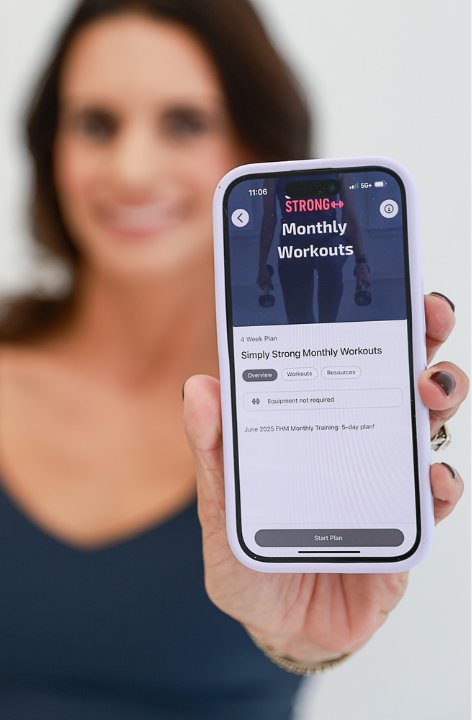
If you’re ready to start your strength training journey from home with a plan that’s designed for results and that builds these progressions in for you - take our quick quiz to see if the Simply Strong App is right for you.