
Quick Summary
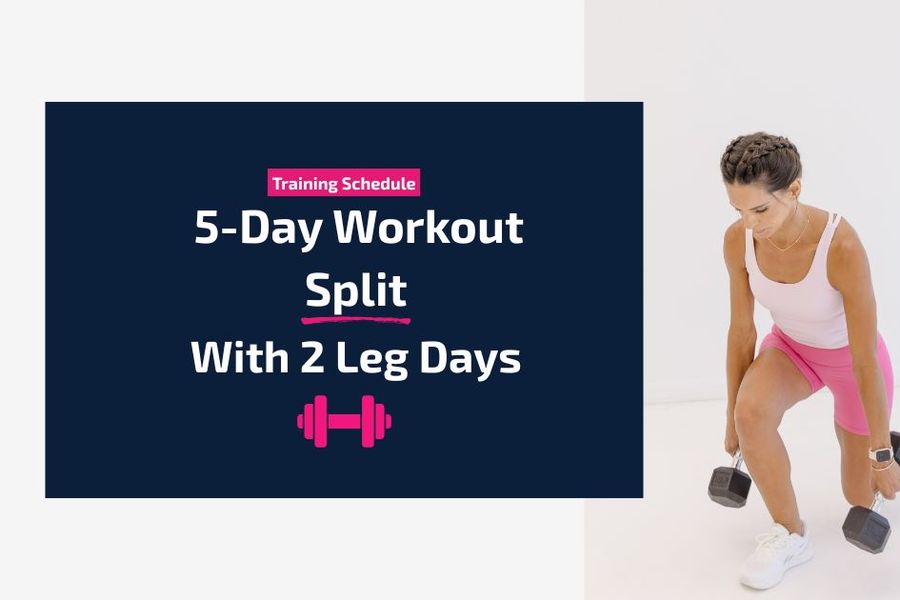
If you're looking for a 5-day-per-week training schedule that includes two dedicated lower-body workouts, this article will give you an example training schedule and approach.
If you’re looking for a strength training routine that builds strength, supports muscle growth, and trains your whole body without needing to spend hours in the gym, a 5-day workout split with 2 leg days is a really popular approach for many women.
There are tons of fitness programs out there that only include one leg day, and while that’s fine, a lot of women have a goal to build and define their legs and glutes, which means additional volume and flexibility with muscle groups is optimal. This training split allows you to train your legs twice each week while still giving them plenty of time to recover in between sessions. The rest of the week is dedicated to upper body strength and a full body conditioning workout, creating a balanced routine that supports both strength and overall fitness.
By the way, if you’re curious about how often women should strength train, you can read my thoughts here.
Why Train Legs Twice Per Week?
Training legs twice per week helps support many women’s goals of strengthening and shaping their legs and glutes. And while you can absolutely build strength with just one weekly lower body workout, training legs twice a week offers several benefits.
It allows you to:
- Increase your weekly training volume.
- Build strength more consistently.
- Focus on different movement patterns.
- Practice key lifts more often.
- Recover better than trying to do every lower-body exercise in one session.
Instead of doing one long, exhausting leg day, you'll have two focused workouts that complement one another. Typically, you’ll find that one session emphasizes quad-dominant movements and the other targets hamstring-dominant movements. This is a balanced approach that helps you develop lower-body strength more effectively over time.
There are lots of different workout splits/schedules that will accomplish this, whether you choose a 3, 4, or 5-day-per week plan.
A Sample 5-Day Workout Split With 2 Leg Days
Here's an example of a balanced weekly schedule that includes two lower body workout days (this is the exact workout schedule we follow in the Simply Strong App 5-day workout plans):
Monday: Lower body I (quads & glutes)
Tuesday: Upper body push + core
Wednesday: Full body conditioning
Thursday: Upper body pull + core
Friday: Lower body II (glutes & hamstrings)
This training split allows every major muscle group to be trained while still leaving adequate time for recovery.
Lower Body I: Quad & Glute Focus
Your first lower body workout of the week should focus on compound exercises that primarily target the quads while still engaging the glutes. Some example exercises include:
- Goblet Squats
- Reverse Lunges
- Step-Ups
- Bulgarian Split Squats
- Glute Bridges
These lower body exercises help build lower-body strength while reinforcing foundational movement patterns you can continue progressing over time.
Upper Push + Core
The second workout of the week shifts your focus to the upper body.
Push muscles include your:
- Chest
- Shoulders
- Triceps
Adding core work at the end creates an efficient workout without making it excessively long.
A typical workout may include:
- Dumbbell Chest Press
- Shoulder Press
- Push-ups
- Lateral Raises
- Triceps Extensions
- Core exercises
Full-Body Conditioning
Unlike traditional cardio, this workout uses strength-based exercises performed at a slightly faster pace to improve both muscular endurance and cardiovascular fitness.
The goal of this workout is to change up your training pace and complement your strength-specific workouts by:
- Increasing your heart rate.
- Improving work capacity.
- Adding variety to the week.
- Reinforcing functional movement patterns.
This is also a great opportunity to include movements that challenge coordination and total-body strength. It’s a fun way to feel athletic and capable!
Lower Body II: Glute & Hamstring Focus
Your second lower-body workout of the week should shift the focus to your posterior chain.
Exercises might include:
- Romanian Deadlifts
- Hip Thrusts
- Banded Deadlifts
- Dumbbell Kickbacks
- Banded Lateral Walks
Because this workout targets different muscles than your first leg day, you're able to continue building strength without overloading the same movement patterns. Plus, you’ll have had a few days between your lower body sessions to allow your muscles to recover and be ready.
Upper Pull + Core
Your second upper body workout of the week focuses on your pulling muscles, which are essential for posture, upper body strength, and balanced muscle development. Pull days focus on back and biceps.
Exercises may include:
- Bent-Over Rows
- Rear Delt Flys
- Banded Lat Pulldowns
- Bicep curls
Training both pushing and pulling muscles each week separately helps create balanced upper-body strength while supporting healthy shoulder function.
Why This Split Works So Well
While it’s certainly not necessary for every woman to train five times per week, if that’s your preferred cadence, following this split has a ton of benefits. One of the biggest benefits is that this split balances training and recovery for a well-rounded plan. Instead of training the same muscles on consecutive days, which can lead to soreness and fatigue, each workout allows the previously trained muscles to recover while another muscle group gets worked.
Plus, it makes it easier to:
- Lift with better quality.
- Recover between sessions.
- Progress your weights over time.
- Stay consistent week after week.
Progressive Overload Is Still the Goal
Regardless of which workout split you follow, your muscles require a reason to adapt if you want them to change. This is where progressive overload comes into play. Rather than constantly searching for new workouts, you shift your focus to gradually improving your performance in the same lifts by:
- Increasing your weights
- Completing more reps
- Improving your form
- Adding another set when appropriate
Is This Workout Split Good for Beginners?
Potentially, but more often than not, I recommend beginners stick to a lighter schedule as they get into the habit of training. A good 3-day full-body split or a 3-day muscle-group-specific split is what I tend to point beginners to.
Whether you want to work out 3, 4, or 5 times per week as a beginner, the biggest key to your success is to follow a structured strength training program consistently.
As your fitness improves and strength training becomes part of your routine, you can always add another workout day if it fits your lifestyle and goals.
FAQs
Is training legs twice a week enough?
Absolutely! For most women, training lower body twice a week provides plenty of stimulus for growth while still prioritizing recovery. Women who have a goal of building muscle in their legs and glutes tend to find that a 2x per week approach is superior to 1x.
Should both leg days be the same?
No, a balanced program will utilize different exercises across the two lower body workouts. This creates a more balanced training program.
Is a 5-day workout split too much?
Not necessarily, but it depends on how long your workouts are, how many exercises you’re doing (volume), and how hard you are pushing yourself. A 5-day workout split works well for women who enjoy exercising most weekdays and have enough time to recover between workouts. If you start to notice that you’re not recovering as well or are struggling to lift as heavy as you’d like, scaling back and focusing on just one quality lower body workout per week can help.
Wrapping Up
As a personal trainer who works with hundreds of women, I have found that the majority of women appreciate having two lower body workouts per week. Unfortunately, it can sometimes be difficult to find a fitness program that offers this (and does it in a way that makes sense).
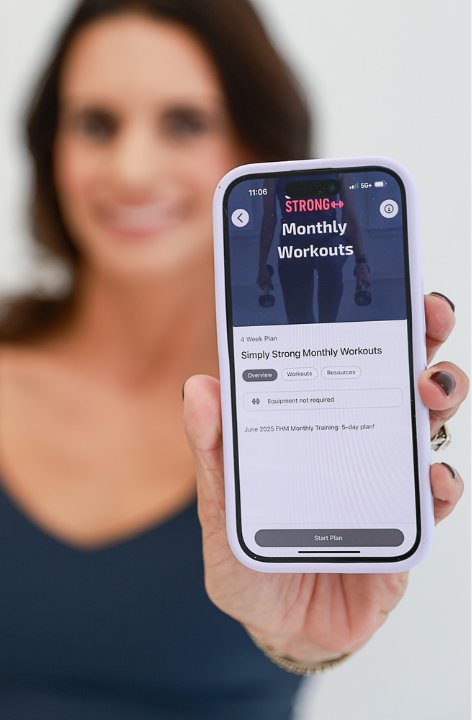
In the Simply Strong App, we have new workout programs monthly. Our 4- and 5-day plans both include 2 separate leg days each week. If you’re looking for a structured workout program that’s designed to get you the best results in the least amount of time, check out the Simply Strong App. Take our quick quiz to find out if you’re ready to start.