
Quick Summary
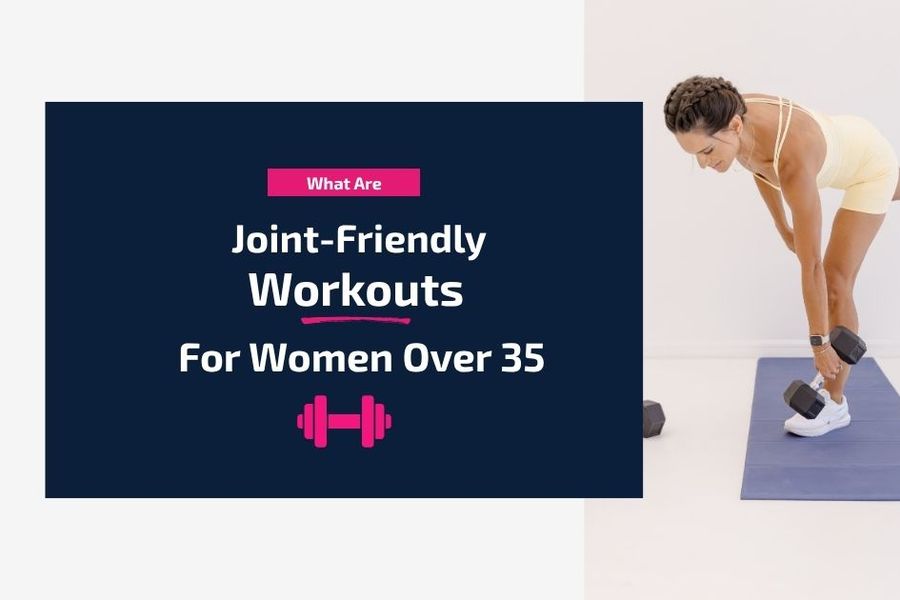
Joint-friendly training doesn't mean easy training. Learn how women over 35 can build strength, manage impact, choose the right exercises, and train effectively without constantly beating up their joints.
Most women over the age of 35 notice at some point that their body doesn’t respond to workouts the same way it did in their 20s or even low 30s.
Maybe your knees don’t love the endless jumping that a lot of traditional fitness programs call for, or maybe your shoulders get cranky after certain exercises. Or, maybe, you simply don’t recover as quickly from back-to-back high-intensity workouts.
Your first thought might be that you need to scale back and stop challenging yourself, but that’s not always the case. Joint-friendly training doesn’t mean easy training. It means being more intentional about how you create training stress so you can build strength without your body taking a constant beating.
The goal during this phase of life isn’t to avoid stress; it’s to give your body the right amount of stress so it can adapt, get stronger, and continue to serve you.
What Does Joint-Friendly Training Actually Mean?
Joint-friendly training means choosing exercises, loads, ranges of motion, and volume that allow you to challenge yourself while still mitigating unnecessary stress on your joints.
And, to be clear, there isn't one universal list of "good" and "bad" exercises. An exercise that feels great for one woman might not feel great for another. The exercises that don’t feel great for you will be dependent on your training history, any previous injuries, mobility, and strength. All of these factors can influence what works for you and what doesn’t feel the greatest.
Instead of approaching an exercise with the question “Is this exercise bad for my joints?” A better question would be “Can I perform this exercise with good control, appropriate loading (weight), and without pain?”
6 Things to Consider When Training for Joint Health
1. Don't Be Afraid of Strength Training
One of the biggest misconceptions about joint-aware training is that you need to avoid lifting heavy weights; you don’t!
The goal doesn’t necessarily need to be to lift as heavy as possible - the goal is to choose challenging weights that allow you to maintain good form and control. That’s where progressive overload comes in.
Instead of always trying to do harder and harder workouts, you gradually increase the challenge as you become stronger. This can mean adding weight, adding reps or an additional set, improving your technique, or using a more challenging variation of the exercise.
2. Choose Exercises That Feel Good for Your Body
You don't have to perform a specific squat, lunge, or pressing variation just because it's popular or trendy. If an exercise doesn't feel good, modify it.
For example, you might swap:
- A traditional squat for a box squat
- A reverse lunge for a supported split squat
- A floor press for another pressing variation
- An unsupported movement for a supported version
The goal isn't to find the hardest exercise; it’s to find an exercise that you can perform consistently and work on progressing with over time.
This is one reason exercise swaps can be so valuable in a strength training program. You can continue training the same movement pattern without forcing your body into an exercise that doesn't work for you.
3. Control Your Range of Motion
More range of motion isn't automatically better, especially if you’re dealing with limitations. There’s no sense in risking injury. You don’t need to force yourself into the deepest possible squat or the biggest movement if you don’t have the ability to control it or do it comfortably.
Instead, work through a range of motion that you can control and gradually improve it over time - think of your range of motion as something you train and practice, not something you force.
4. Manage Impact
Being over 35 doesn't mean you need to eliminate jumping, running, or other higher-impact activities. Impact is simply another training variable. For women over 35, it’s important to control how often you use it, how much you do it, and how you recover between sessions.
For example, you might include a conditioning workout once or twice per week while keeping the majority of your training focused on strength and lower-impact movement.
5. Don't Make Every Workout an All-Out Workout
Your workouts don’t need to completely exhaust you to be effective - there’s a big difference between sweaty and effective workouts.
You don't need to take every set to failure, chase massive soreness, or finish every workout feeling like you couldn't possibly have done another minute. All that creates is a recipe for burnout. For most women, working hard in their sets while leaving roughly 1- 3 good reps in reserve is a great target to aim for.
This way, you’re challenging your muscle appropriately without piling on unnecessary fatigue. The result of this approach is that you’ll be able to show up for your next training session with energy and strength.
6. Recovery Is Part of Joint-Friendly Training
Recovery is a key part of your training plan. It’s the time your body needs to adapt to the stress you’re placing on it. This means paying attention to:
- Sleep
- Rest days
- Workout frequency
- Training volume
- Your overall stress
- How you feel going into your workouts
The goal is to find the amount of training you can recover from and consistently progress with.
How Joint-Friendly Training Fits Into Simply Strong
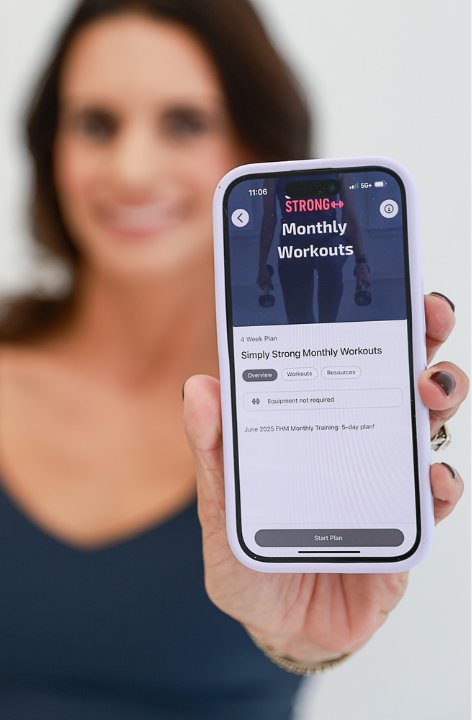
This is one of the reasons Simply Strong uses structured programming instead of constantly giving you a brand-new workout each week. We repeat the same exercises for 4-5 weeks at a time before moving on to the next month’s exercises.
The workouts build on each other throughout the month, giving you the opportunity to practice movements, improve your form, track your weights and reps, and progressively increase the challenge.
We also have exercise swaps and modifications available when you need them. The goal is to build strength in a way you can maintain consistently, not to see how much punishment you can tolerate in a single workout.
Final Thoughts
Joint-friendly training isn't about avoiding challenging exercises; it’s about building a body that can handle more in a safe and effective way. As a woman over 35, you don’t need to stop lifting weights or start treating your body like it’s fragile. You simply need to be more intentional about the way you train and recover. Strength training for women over 35 should be a non-negotiable.
Focus on progressive strength training, use modifications and swaps when you need them, control the exercises and the load you’re placing on your body, and manage your training volume and recovery. With this approach, you will build muscle, get stronger, take care of your joints, and be able to continue to remain mobile and pain-free through aging.
Take the Simply Strong Quiz to see if the Simply Strong App is a good fit for you.