
Quick Summary
A workout can leave you sweaty and exhausted without actually moving you closer to your goals. Learn why effective training is about more than intensity, and how progressive overload, consistency, and recovery can help you get better results from the work you're already doing.
When you finish every workout completely exhausted, sweaty, and already sore, it’s easy to assume that you had a “good workout” and made progress. But here’s the thing: a hard workout is not necessarily an effective workout.
There’s a big difference between exercising as hard as you can and following a structured training program that’s designed to get you stronger, build muscle, and improve your fitness over time.
I know this because I used to be one of those people who thought the harder and sweatier the workout, the better. I would do more HIIT, more cardio, longer workouts, and a higher calorie burn on my watch… but eventually I realized that constantly pushing myself and never taking rest days wasn’t making me stronger or helping me change my body; it was just making me tired and rundown.
When I finally shifted my focus to structured strength training, progressive overload, recovery, and consistency, my workouts became much more intentional and much more effective.
What Does It Mean to Work Hard?
When it comes down to it, working hard simply means you're putting effort into your workout.
You might:
- Sweat a lot
- Get your heart rate up
- Feel completely exhausted afterward
- Experience muscle soreness
- Push yourself to your limit
- Burn a lot of calories
None of those things are inherently bad - in fact, effort is a critical factor in training. But it’s not just effort alone that counts. You can work really hard without ever progressing or experiencing results - this is what we like to refer to as “spinning your wheels,” and it’s not a great feeling. The goal is to work hard, but in a smart, efficient way.
What Does It Mean to Train Effectively?
Training effectively involves workouts that are intentionally designed around your goal. For most women who start a strength training program, their goals include building strength and muscle, improving their body composition, aging more gracefully, and protecting their bodies through age.
If any of these are your goals, an effective program should include things like:
- Progressive overload
- Appropriate training volume
- Repeated movement patterns
- Adequate recovery
- Consistent training
- A way to track your progress
Your workouts don't need to leave you crawling out of the room to be effective (thankfully!); they just need to provide the right stimulus and to then give your body the opportunity to adapt, change, and grow.
Hard Work vs. Effective Training
| Working Hard vs. Training Effectively | Training Effectively | Working Hard |
|---|---|---|
| Difference 1 | Chasing progress | Chasing exhaustion |
| Difference 2 | Doing what you need | Doing more |
| Difference 3 | Following a structured program | Changing workout constantly |
| Difference 4 | Measuring strength | Measuring sweat |
| Difference 5 | Trying to build muscle | Trying to burn calories |
| Difference 6 | Using appropriate intensity | Going all-out every workout |
| Difference 7 | Prioritizing recovery | Ignoring reovery |
| Difference 8 | Consistent progression | No pain, no gain |
You Don't Need to Be Sore After Every Workout
One of the biggest misconceptions about strength training is that you need to be sore after every workout or it wasn’t effective. A lot of women use soreness as their proof that their workout was effective, but soreness isn’t a reliable measure of progress. You can have a very productive strength training session and not be sore at all the next day.
If you’re going around chasing soreness with every workout, your ability to keep working out suffers - it’s a good way to burn out and quit. Soreness isn’t a sign that you’re training better; in fact, it might be a sign that you’re doing more than you’re able to recover from.
You Don't Need to Be Exhausted After Every Workout
A good strength workout should challenge you, but it shouldn’t leave you feeling like you were hit by a truck. This is especially important for women over 35. The older we get, the more important recovery becomes. Your goal should be to create enough stimulus to encourage adaptation without feeling completely drained after your session.
This is one reason why following a structured training program (especially one made with women over 35 in mind) is so valuable. Your workouts are structured in a way that allows for ample recovery time between sessions and muscle groups, and the training is designed to elicit the best possible results with the least amount of stimulation.
Progressive Overload Matters More Than Sweat
The most efficient way to build muscle is via progressive overload, which is to gradually increase the challenge placed on your muscles over time. This can look like:
- Using heavier dumbbells
- Adding more reps
- Performing an exercise with better form
- Adding an extra set
- Increasing the time spent under tension
- Using a more challenging variation
A real-life example of this would be performing 10 goblet squats with a 25-pound dumbbell this month and then being able to perform the same exercise with a 30-pound dumbbell the next month - that’s measurable progress. You don’t need a new workout every time you exercise; you need a reason to get better at the workouts you’re already doing.
If the concept of progressive overload is new to you, check out Progressive Overload With the Same Dumbbells for practical ways to keep progressing even when your equipment is limited.
More Exercise Isn't Always Better
I really want my ladies over 35 to hear this: more is not better when it comes to fitness at this stage of life - more is just more. It can be hard to hear this because fitness culture on social media rewards doing more, but your body isn’t actually getting stronger while you’re exercising; it’s getting stronger when you’re resting.
What this means is that doing 5 intense workouts isn’t automatically better than doing 4 well-programmed strength workouts. In fact, 5 intense workouts per week will likely leave you feeling exhausted, sore, and ready to give up. The key is to do less, but to do it better and more strategically. Work smarter, not harder.
Why Random Workouts Can Feel Productive
Doing random workouts like the ones you find on YouTube or saved on IG can feel really productive. You finish a HIIT workout and think “wow, that was hard! I’m dripping sweat” - and while that might be true, if every workout you do is random, you’re missing a really important piece of strength training, and that’s the ability to measure progress.
If your goals include getting stronger, building muscle, and changing your body composition, you’ll struggle to accomplish that when you aren’t able to track your progress. You won’t know if you’re getting stronger if you’re not repeating the same exercises/workouts.
Variety can have a place in your routine, but your primary strength workouts should have some consistency, tracking, and progression built into them.
What Effective Strength Training Actually Looks Like
Effective strength training is actually really simple. You follow a planned program that asks you to show up for basic strength exercises, you challenge yourself with weights and good form, you rest between sets, you track what you did, and then you come back the next week and try to make increases and/or improvements.
While this approach may not look or feel as exciting as the fun, different daily workouts you’ll find on Instagram or YouTube, I can promise you that you’ll get far better results by doing it this way, and you’ll spend a lot less time spinning your wheels.
How to Know If Your Program Is Working
Whether or not something is “working” depends on what your goals are, but here are some prompts to help you determine if you’re getting results:
Am I getting stronger?
Are you lifting heavier weights or completing more reps than you were several weeks ago?
Is my form improving?
Do I have better control and/or technique? These things can be improved even if your weights and reps haven’t changed.
Am I recovering between workouts?
Am I able to complete my next training session without feeling completely depleted?
Am I consistent?
The best program in the world won't work if you aren't following it. You don’t have to be perfect; you just have to keep showing up.
The Simply Strong Approach
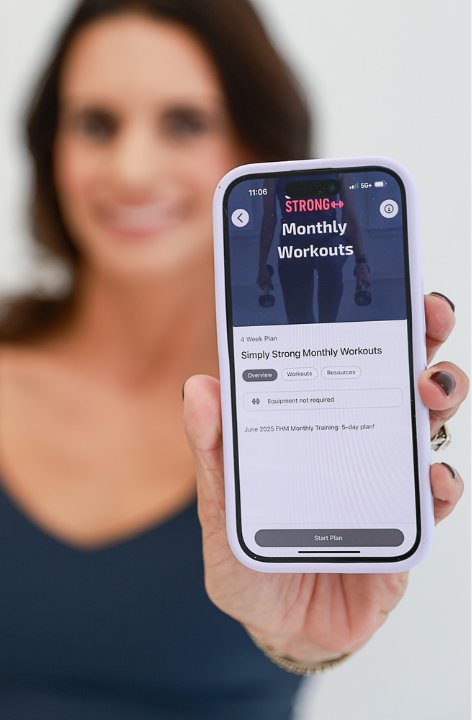
This is one of the biggest reasons I built Simply Strong the way I did. I wanted to build an app that would eliminate the guessing - I didn’t want women to feel like they need to wake up every morning and figure out what workout they should do. I take care of all of the planning for them.
Simply Strong uses structured monthly programming that’s built around progressive overload. We repeat key movements, track our reps and weights, have clear sets, reps, and rest periods, and have a plan for progressing.
We take a simple, effective approach to strength training that’s clear, concise, and easy to be realistically consistent with. I like to think of the Simply Strong approach as a “mature” approach to fitness.
Come see for yourself, and get 50% off your first month. Take this quick quiz to see if the Simply Strong App is a good fit for you.