

Quick Summary
Not seeing the results you expected from your strength training routine? This guide breaks down the most common plateaus women experience, why they happen, and the simple changes that can help you start progressing again.
The Most Common Strength Training Plateaus for Women (And How to Break Through Them)
At some point, almost every woman experiences a plateau in their strength training journey. Maybe you’ve been lifting the same weight for weeks and can’t seem to make any increases, or you stopped seeing visible changes in your physique, or maybe you’re working just as hard as ever, but your progress has significantly slowed.
Whatever type of plateau has got you feeling discouraged, know that it’s completely normal, albeit very frustrating. The most important thing to understand is why you’ve hit a plateau and what you can do to move past it.
In this article, I’m going to touch on some of the most common strength training plateaus women experience and how you can overcome them.
What Is a Strength Training Plateau?
A strength training plateau is simply a stall in progress for an extended period of time. This could mean:
- You're no longer getting stronger
- Your lifts feel the same week after week
- Your body composition hasn't changed
- You're no longer increasing your weights or reps
- Your motivation starts to decline because you don't feel like you're making progress
The good news is that most plateaus aren't permanent, and most of the time you can take steps to move past those plateaus.
Plateau #1: You're Lifting the Same Weight Every Workout
If you’ve been using the same weights for months on the same exercises, without increasing the challenge, your muscles have likely adapted to the stimulus you’ve been placing on them.
How to break through it:
- Increase your weight when appropriate
- Add more reps
- Add another set
- Slow down your tempo
- Progress to a more challenging exercise variation
Small changes are often enough to stimulate new progress.
Plateau #2: You're Changing Workouts Too Often
Contrary to popular belief, switching your workouts up all the time isn’t how you “keep your muscles guessing” so you keep seeing progress. Ironically, this is actually how a lot of plateaus happen; it’s not prevention against them.
When every workout you do is different, it’s difficult to measure progress because you’re not repeating the same exercises long enough to improve them. It’s the repetition of the exercise plus progressive overload that provides the stimulus for your muscles to grow and get stronger.
How to break through it:
Follow a structured strength training program that repeats key exercises for several weeks before progressing them. If you’re worried about it being boring to repeat workouts, I promise you won’t find it boring when it’s working.
Plateau #3: You're Not Eating Enough Protein
While your workouts and the load you’re placing on your muscles create the stimulus for muscle growth, it’s your daily protein intake that provides the building blocks your muscles need to recover and adapt. Without proper protein intake, your progress can feel a lot slower, even when you’re strength training consistently.
How to break through it:
Figure out how much protein you need each day (I recommend .8-1g per pound of body weight), and then make sure you’re building your meals and snacks around protein. I like to make protein the centerpiece of every meal and then build the rest of my meals around my protein source.
Plateau #4: You're Skipping Recovery
Many women assume that the answer to breaking through a strength training plateau is to work out harder, but the truth is that sometimes the answer is to prioritize more recovery. Sleep, stress management, and rest days all play a part in how well your body adapts and responds to training. There comes a point, especially for women over 35, where doing more is actually creating more of a problem, especially from a hormonal standpoint, which can easily cause a strength plateau.
How to break through it:
- Prioritize sleep (7-9 hours per night)
- Schedule rest days (at least 2 per week)
- Avoid turning every workout into a high-intensity session (calorie burn isn’t what we’re chasing)
Plateau #5: You're Only Measuring Success by the Scale
If you’re only measuring your success by the number on the scale, you’re likely going to be in for some disappointment. The scale may stay the same even while you're:
- Building muscle
- Losing body fat
- Improving your strength
- Feeling more energetic
- Fitting better into your clothes
If you're only looking at your weight, you may miss the inevitable progress that's happening elsewhere.
How to break through it:
Make sure you’re tracking multiple forms of progress, including strength, measurements, progress photos, energy levels, consistency, and how your clothes fit.
Plateau #6: You're Not Following Progressive Overload
Your body is really smart - it will adapt to what you repeatedly ask it to do. When you show up for your workouts week after week without making any incremental changes/increases, your progress will naturally slow.
How to break through it:
Focus on making one small improvement each week (progressive overload), whether that's:
- One more rep
- A slightly heavier dumbbell
- Better technique
- An additional set
- A slower tempo
Consistency paired with small increases is what will help you break a plateau and see the best results over time.
Plateau #7: You're Expecting Results Too Quickly
No one likes to hear this, but it’s important to manage your expectations when it comes to strength training - it’s not a quick fix; it’s a long-term investment. Some women expect visible changes to be apparent within a few weeks, but meaningful muscle growth and body recomposition take time.
How to break through it:
It’s important to celebrate performance improvements just as much as physical ones. For example, being able to pick up heavier dumbbells, complete more reps, not get as sore or fatigued after a workout, etc. Getting stronger is often the first sign that your program is working, and it should serve as encouragement to keep going.
How to Prevent Future Plateaus
There’s no way to avoid every plateau; they’re more or less inevitable on a strength training journey, but you can reduce how often they happen by:
- Following a structured program
- Repeating workouts long enough to measure progress
- Applying progressive overload
- Eating enough protein
- Prioritizing recovery
- Tracking your workouts
- Staying patient and celebrating non-scale and strength wins
The Bottom Line
Hitting a strength plateau doesn’t mean that you’ve failed. In fact, it’s often just a sign that your body has adapted to your current routine and that you’re ready to move onto stronger pastures. But the solution is rarely to work harder; it’s usually to train smarter.
To do this, you’ll want to make sure you’re following a structured strength training program, applying progressive overload, making recovery a priority, and showing up consistently. If you can do this, you’ll continue to build strength long after the plateau passes.
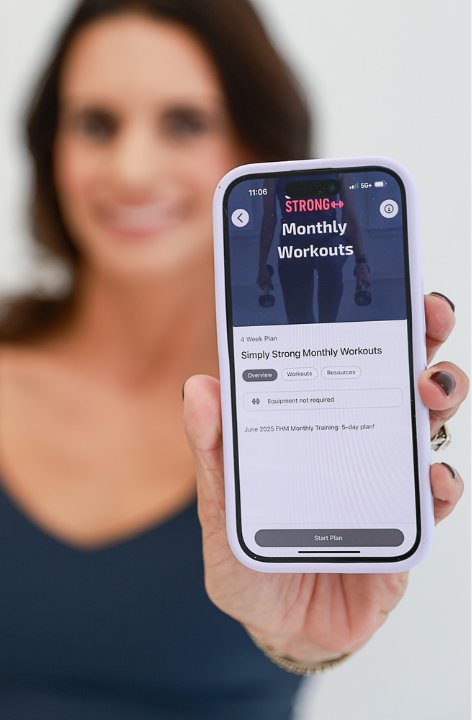
If you’re looking for a program that helps keep plateaus at bay and progress chugging along, take my quick quiz to see if the Simply Strong App, my strength training program where I take care of all of this for you, is a good fit for your strength training needs.