
Quick Summary
If you've ever heard the saying "random workouts create random results" and wondered what that meant, this article will explain to you the importance of following a structured strength training plan.
If you’ve ever searched Google, YouTube, Instagram, or TikTok for a workout, you’ve probably noticed that every workout you find is completely different. One day it’s a HIIT circuit, then a Pilates workout, and then maybe a “100-calorie burner.”
While variety can keep exercise interesting, constantly doing random workouts is one of the biggest reasons why women stay stuck and don’t see the progress they’re working towards. If your goal is to get stronger, build muscle, lose body fat, or improve your body composition, you need to be following a structured workout plan. Your workouts need to do more than just make you sweat - they need to build on one another.
Random workouts lead to random results.
What Are Random Workouts?
Random workouts are exactly what they sound like - they aren’t part of any kind of structured program; they’re just one-off routines that you might choose to follow based on:
- What's on YouTube that day
- What shows up on your social media feed
- Whatever sounds fun that morning
- Whatever body part you're in the mood to train
There isn't necessarily a plan connecting today's workout to tomorrow's or the next day’s - it’s just random. And while I will always advocate that moving your body is always a positive and any movement is good movement, random workouts make it much harder to measure and create progress.
Why Random Workouts Don't Build Strength
Think of strength training as a skill similar to learning a language or how to play an instrument - you improve your skill through repetition and gradual progressions. If you’re constantly changing exercises, your body spends more time learning new movement patterns than improving existing ones.
Instead of spending your time getting better at the basics (squats, deadlifts, rows, and presses), you’re always starting over with something new. If you’re always starting over, you’ll never get better, and it’s the process of slowly getting better (adding more over time) that actually creates results. If you want your body to change, you need to give it a reason to. Adaptation is built through repetition.
You Can't Apply Progressive Overload
One of the biggest principles of effective and efficient strength training is progressive overload. In order for your muscles to build strength, they need a reason to adapt, and this can come in multiple forms:
- Lifting a heavier dumbbell
- Completing another repetition
- Adding another set
- Improving your technique
- Slowing your tempo
And you need to track all of this. But if you never repeat a workout or specific exercises, how do you know if you've improved? There’s no sense in tracking your reps and weights for an exercise that you have no intention of repeating.
You can't compare today's workout to last week’s if they're completely different. This makes progress really difficult to measure.
You Never Build Confidence
Workout repetition isn’t boring; it’s actually very empowering. The first time you perform an exercise, you’re starting to figure out how to do the movement and how to get your form right. By the second or third week, your confidence is starting to grow, and by week four, you’re lifting heavier and moving with greater ease. You start to realize just how strong you’ve become over the course of those four weeks because you have the evidence - that’s incredibly motivating.
Random Workouts Make It Harder to Track Progress
Imagine trying to improve your mile time by running a different distance every day or trying to get better at baking cookies, but making a different dessert each night. Without consistency, it’s difficult to know whether or not you’re improving. The same concept applies to strength training.
In order to track your progress and make sure you’re improving and getting stronger, you have to be consistent with your approach.
Why Structured Programs Work Better
A solid strength training program is intentionally designed, which means exercises aren’t chosen randomly, and the workouts build on one another. The exercises that are selected complement one another and create the opportunity for growth and balanced progress over time.
A structured program should include:
- Planned workout splits
- Repeated movement patterns
- Progressive overload
- Scheduled recovery
- Balanced muscle group training
Each workout should prepare you for the next one and should guide you on how to progress so you can keep getting stronger, building lean muscle, and changing your body composition.
So Does That Mean You Should Never Change Your Workouts?
No, not at all! You aren’t doomed to do the exact same workouts every single week from here until eternity. Your workouts should evolve and change, just not every day. Most structured strength training programs repeat workouts for several weeks before introducing new exercises or progressions.
Taking this approach gives you enough time to:
- Learn proper technique
- Increase your strength
- Track improvements
- Build confidence
Once you've made progress for an appropriate amount of time, switching it up and trying some new exercises that work the same muscle groups or that are a progression from what you’ve been doing will provide your muscles with a new challenge while keeping your training fresh.
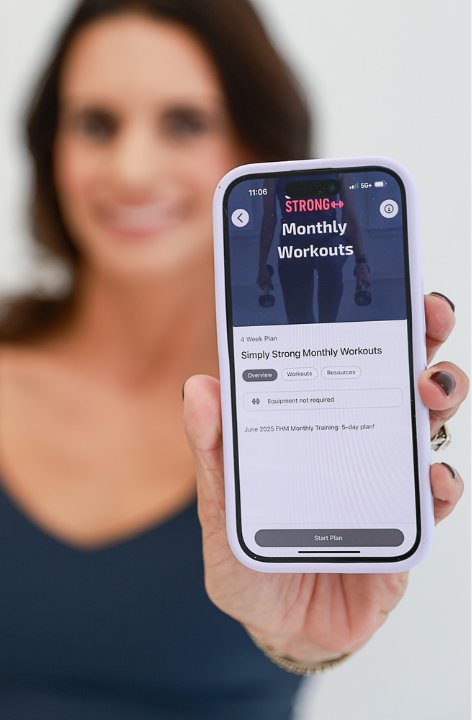
In the Simply Strong App, we change our workout programs every 4 weeks (monthly) so we have plenty of opportunities to make progress each month but aren’t completely bored and checked out of our training.
Signs That Your Workouts Are Too Random
You might be wondering what constitutes random workouts; you might be relying on random workouts if:
- You never repeat the same workout.
- You can't remember what you lifted last week.
- Every workout comes from a different creator.
- You don't track your weights or reps.
- You're sore all the time but don't feel stronger.
- You're constantly looking for the "perfect" workout instead of following a plan.
- Your body composition isn’t changing.
If any of these sound familiar, it may be time to trade variety for structure. And I promise, you won’t be bored because you’ll start seeing much better results.
What to Do Instead of Random Workouts
Rather than searching for a new workout every day, choose a program that gives you a clear path forward while being realistic and doable for your schedule.
Look for one that includes:
- Progressive overload
- Repeated exercises
- Structured workout splits
- Planned recovery
- Clear sets, reps, and rest periods
A good training program will remove all the guesswork by giving you a plan and a method (usually an app) to track your progress. Read this guide for my tips on how to choose a strength training app for women.
Frequently Asked Questions
Aren't muscles supposed to be "confused"?
No, this is a popular fitness myth, but there’s no merit to it. Your muscles don’t need confusion; they need a consistent challenge that gradually increases over time. This requires repetition and tracking.
How long should I repeat the same workouts?
Most well-designed strength programs repeat workouts for four to six weeks before introducing meaningful changes. This tends to be the sweet spot for many women as it offers ample time to adapt and make progress with the workouts without burnout or boredom setting in.
Will I get bored repeating workouts?
No, in fact, most women find that the opposite happens (especially for women over 35). As you get stronger, repeating workouts becomes more rewarding because you can clearly see and feel your progress by lifting heavier weights, completing more reps, or improving your form and technique.
Wrapping Up
Random workouts are fine if your goal is to just get your body moving and to improve your overall health. However, at some point, most women find that the work and effort they are putting into those workouts aren’t giving them much of a return on investment.
If your goal is to change your body composition (decrease body fat and increase muscle mass), get stronger, and protect your body as it ages, then you should consider following a structured strength training program that takes care of all the guesswork for you.
A structured strength training program gives you something random workouts can't: A plan and a method for tracking your progress.
When your workouts build on one another, you can measure progress, apply progressive overload, and watch yourself become stronger week after week.
And that's exactly how lasting results are built. If you’re ready to follow a plan that’s designed to give you the best results in the least amount of time, take the quiz and get 50% off your first month in the Simply Strong App.