
Quick Summary
Repeating exercises isn't a sign that your workout is boring or ineffective; it's how you get better. Learn why practicing the same movements, tracking your performance, and gradually increasing the challenge are key to building strength and making measurable progress.
If you’ve been told that you need to “confuse your muscles” to get results, please hear me when I tell you that this is not true. You do not need a brand-new workout every time you exercise. In fact, if your goal is to get stronger, build muscle, improve your form, and actually see measurable progress, then repeating movements is one of the most useful things you can do.
You can’t get better at something you never practice, and strength training is no different.
Strength Training Is a Skill
When you perform some of the most basic strength training exercises like squats, rows, and presses, you’re not just moving weight around; you’re learning how to move your body efficiently. You’re practicing things like:
- Bracing your core
- Finding the right range of motion
- Controlling the weight
- Maintaining proper positioning and form
- Coordinating multiple muscles and joints
- Understanding what the movement should feel like
- Challenging yourself without sacrificing your form
The first time you perform an exercise, there’s a lot to think about; but the more you practice it, the more natural it becomes. That’s the goal! You want to get really good at these exercises because they translate to real-life strength and mobility.
Think about any physical skill you’ve ever learned - you didn’t become better at it by doing it once and then never doing it again. You practiced it over and over again until you gained confidence with it. Strength training works this exact same way.
You Can't Measure What You Don't Repeat
This is one of the biggest reasons I believe in repeating movements. If you’re constantly changing up your exercises, it becomes really difficult to measure your progress and see if you’re actually getting stronger and more proficient.
Let’s say you’re doing goblet squats one week, sumo squats the next, step-ups the week after, and then some completely different lower-body exercise the next. You might be working hard and “feeling the burn” every time, but you have no way of measuring progress, and you’re not giving your body a reason to adapt (which is the exact reason why most people are strength training in the first place).
Now imagine you perform goblet squats consistently and track what you’re doing over the course of 4 weeks. Your progress could look something like this:
Week 1: 10 reps x 15 lbs
Week 2: 10 reps x 20 lbs
Week 3: 12 reps x 20 lbs
Week 4: 10 reps x 30 lbs
You made some kind of progress each week, whether it be by increasing your weight or your reps. And if you’re tracking this information, you’ll be able to actually see the increases you’re making.
But keep in mind that progress doesn’t always mean adding more weight or reps. It can also come in the form of improved execution, great range of motion, additional stability, etc. All of those are also signs that you’re getting better.
Repeating an Exercise Doesn't Mean Your Workout Isn't Working Or That It’s Boring
I think this is where a lot of women get hung up. We’ve been conditioned to believe that if a workout doesn’t leave us dripping in sweat or include new, “fun” exercises that we’ve never seen before, then it must not be effective. Or, if you’re repeating the same exercises, you’ll be bored to tears.
The truth is, the most productive workouts are the ones where you know exactly what you’re doing. You know the exercises because you’ve done them before; you know what weight you used last time because you tracked it, and you have a clear goal: do a little better than you did before.
That is progressive overload, and that is exactly how you build strength and see the best results.
You Don't Need to “Confuse Your Muscles”
Ladies, it’s time to retire the idea that you need to constantly switch up your workouts to “keep your muscles guessing.” This is basically an old wives’ tale.
Your muscles aren’t sitting there thinking: “Wait a minute, haven’t we done lunges before?” Muscles respond to the demands you place on them. If you consistently challenge your muscles with enough resistance and gradually increase that challenge over time, your body has a reason to adapt. And adaptation is what causes your muscles to grow and change.
How to Progress Without Changing the Exercise
One of my favorite things about repeating movements is that there are so many ways to make an exercise more challenging without replacing it entirely.
You can:
Increase the weight: this is the most obvious form of progressive overload, but it’s not the only one.
Increase your reps: If you’re doing an exercise with 20 lb dumbbells and aren’t quite ready to bump up to 25 lb dumbbells yet, you might be able to add a couple more quality reps with your 20 lb dumbbells first.
Improve your form: Better control and positioning can make the same weight significantly more challenging.
Increase your range of motion: If your mobility and control allow for it, gradually working through a greater range of motion can be meaningful progress.
Improve your control: Slowing down the eccentric portion of a movement, adding a pause, or eliminating momentum can make an exercise much more difficult.
Become more stable and confident: Sometimes progress looks like a movement simply feeling easier and more natural.
Not every workout needs to end with a heavier dumbbell in your hand to count as progress. There are so many ways to measure your progress!
This Is Why I Don't Change Everything Every Week
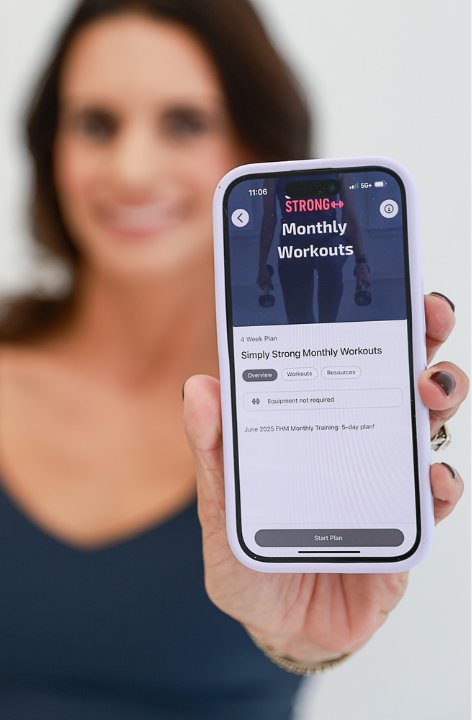
When I create workouts for the Simply Strong App, I create them with progressive overload in mind. I don’t want my clients to open their app every Monday and wonder, “What the heck am I doing today”? And I definitely don’t want them doing an exercise once and then never doing it again.
I program the workouts so that you have the opportunity to practice movements, track your performance, and build on what you did previously. You will see the same exercises repeated throughout the month and similar exercises programmed in subsequent months because we’re never starting over from scratch. We’re always building and always progressing.
When you see reverse lunges programmed, I want you to look at your exercise history and think:
Ok, last time I used 30s for 8 reps, can I do 35s this time? Or can I do 30s for 10 reps? Or I want you to take note of things like finally feeling confident with the exercise, having better stamina, performing it with better form and control, etc. These small improvements all add up over time to a stronger and more capable version of yourself.
But Should You Ever Change Your Exercises?
Of course! Repeating movements doesn’t mean you’re doomed to follow the exact same routine for the rest of your life. In the Simply Strong App, we change our workouts up every 4-5 weeks (monthly). You follow the same workouts for a month, focusing on getting stronger in your lifts, and then we switch to the next month’s program. But as I mentioned before, we don’t completely start over from scratch, as each month builds on the former.
Typically, workout programs that are focused on progressive overload will have you repeating workouts for anywhere from 4-12 weeks at a time. I find that 4 weeks is the sweet spot for most women over 35, as it allows us to make progress but prevents us from feeling bored and unmotivated.
Final Thoughts
Repeating exercises with the intention of getting stronger is the best way to make and feel measurable progress in your strength and muscle. For many women, embracing this concept takes a bit of a mindset shift, as most of us grew up under the impression that workouts needed to be novel and different in order for them to “work.”
In the Simply Strong App, I take a moderate approach to strength training, balancing our desire for novelty and the science that tells us that repetition is the key to results. We focus on training in 4-5 week blocks, tracking our progress and looking for areas of improvement. Then, we switch up the exercises without abandoning the progress we made in the month prior.
If this sounds like a good training fit for you, take my quick quiz, which will help you decide if Simply Strong is right for you!