Quick Summary
This workout plan for women to build muscle combines structured strength training, progressive overload, and practical nutrition to help you build muscle at home. Learn how many days to train, what exercises to include, and how to make steady progress without spending hours in the gym.
Good news: building muscle as a woman doesn’t require spending hours in the gym, doing hour-long workouts, or following a fancy workout routine. All you need is a structured strength training plan that challenges your muscles, gives you enough time to recover, and encourages you to gradually get stronger over time.
Whether you’re brand new to lifting weights or you’ve been exercising for years but just aren’t seeing the results and progress you’d like, having a clear plan will make all the difference. Instead of wasting time guessing what exercises to do each day, you can follow a consistent routine, track your progress, and make improvements as your strength improves.
For most women, a three- to four-day weekly training split is plenty to build muscle while leaving plenty of room for walking, other activities you enjoy, and recovery. And the best part is that this can all be done from home with dumbbells.
In this guide, I’ll walk you through a sample four-day workout split for women who want to build muscle, explain how to choose your weights and reps, and cover the nutrition and recovery habits that will support your muscle growth.
What Is the Best Workout Plan for Women to Build Muscle?
The best workout plan for women to build muscle is one that combines consistent strength training with challenging sets, progressive overload, and adequate recovery. You don’t need a special workout plan because you’re a woman; the fundamental principles of muscle building apply to both men and women. That being said, your starting strength, experience, goals, and individual circumstances will influence how you train.
An effective muscle-building program should include several key elements, including:
Consistent strength training. It’s important to train your major muscle groups regularly rather than focusing exclusively on one area of your body. A good strength training program should include movements that work your legs, glutes, back, chest, shoulders, arms, and core throughout the week.
Enough resistance to challenge your muscles. Your weights should make your working sets challenging without forcing you to sacrifice good technique. As you become stronger, you will need to increase the resistance and challenge placed on your muscles to keep seeing progress. This guide will help you understand how heavy women should lift.
Progressive overload. Your muscles adapt to the demands you place on them. Over time, you need to gradually increase the challenge through additional repetitions, heavier weights, or other appropriate progressions - this is what we refer to as progressive overload, and it’s key for muscle building.
Adequate recovery. Your muscles need time between challenging sessions to recover and adapt; this is the time that your muscles are actually growing. More workouts aren't automatically better, particularly if you're struggling to recover or consistently feeling run-down.
Nutrition that supports your goals. Building muscle requires sufficient protein and adequate overall calories. Consistently under-eating can make it harder to recover and support muscle growth.
You also don't need a different workout every day. Repeating exercises allows you to practice your technique and compare your performance over time. This is the approach to take so you can see that you’re actually improving and getting stronger.
How Many Days a Week Should Women Work Out to Build Muscle?
Most women are surprised to discover that it takes significantly less than they think to build muscle. For the majority of women, training 3-5x per week is plenty of training stimulus for muscle growth. And there isn’t one “best” schedule; it’ll depend on your experience level, goals, availability, and ability to recover.
For most of the women I work with, three or four strength-training sessions per week offers a good balance between providing enough training stimulus and keeping the routine manageable.
Here's a good way to think about it:
3 days per week: Great for beginners, busy schedules, and women who enjoy the flexibility to be able to mix in other fitness activities throughout the week.
4 days per week: Great for women who want to split their training between upper and lower body and train legs twice per week.
5 days per week: Great for experienced exercisers who enjoy more frequent sessions and who have the ability to recover well.
Training more frequently doesn't automatically lead to more muscle growth. What matters is the quality and consistency of your training, the amount of challenging work you complete over the week, and whether you can recover between sessions.
If you're just getting started, a three-day program is a great place to start. If you already have a consistent training routine, a four-day split can give you more room to distribute your exercises across the week.
The four-day plan below is one of the most popular training splits for women as it provides a good balance between muscle building and recovery.
A 4-Day Workout Plan for Women to Build Muscle
This sample 4-day workout plan uses dumbbells, bands, and a bench or sturdy chair. Following this plan will have you training your muscle groups across four distinct training days per week with 2 upper body workouts, split into pushing and pulling exercises, and 2 lower body workouts to train legs and glutes.
Your weekly workout schedule
Monday: Lower body I
Tuesday: Upper body push (shoulders, chest, triceps)
Wednesday: Rest or easy movement
Thursday: Upper body pull (back, biceps)
Friday: Lower body 2
You can move the days around to fit your schedule. The most important thing is to follow the plan consistently and avoid cramming all your workouts together when you need more recovery time. I also don’t recommend doing the lower body workouts back to back; it’s best to leave at least a day or two of recovery in between them.
Workout 1: Lower Body
This first lower body workout focuses on your quads, glutes, and hamstrings using a combination of squatting and hinging movements. Here’s what you’ll be doing:
- Goblet squats: 3 sets x 8-12 reps
- RDLs: 3 sets x 8-12 reps
- Reverse lunges: 2 sets x 8-10 reps per leg
- Weighted glute bridges: 2 sets x 10-12 reps
- Banded lateral walks: 2 sets x 10-12 reps per side
Workout 2: Upper Body 1
This workout emphasizes your chest, shoulders, and triceps, with a combination of pressing and accessory exercises.
- Chest presses: 3 sets x 8-10 reps
- Shoulder presses: 3 sets x 8-10 reps
- Lateral raises: 2 sets x 10-12 reps
- Overhead triceps extensions: 2 sets x 10-12 reps
- Dead bugs: 2 sets x 8-10 reps per side
Workout 3: Lower Body
Your second lower-body workout includes unilateral exercises and additional glute and hamstring work.
Single leg RDLs: 3 sets x 8-10 reps each leg
- Hip thrusts: 3 sets x 10-12 reps
- Bulgarian split squats: 2 sets x 8-10 reps each leg
- Banded glute bridges: 2 sets x 10-12 reps
- Step-ups: 2 sets x 8-10 reps each leg
Workout 4: Upper Body 2
This session emphasizes your back and biceps while including another chest movement to support balanced upper-body training.
- Single-arm dumbbell rows: 3 sets x 8-10 reps each arm
- Rear delt flys: 3 sets x 8-10 reps
- Chest flys: 2 sets x 8-10 reps
- Bicep curls: 2 sets x 8-10 reps
- Bird dogs: 2 sets x 8-10 reps per side
How Many Sets and Reps Should Women Do to Build Muscle?
There isn’t a magic number of reps or sets for each exercise that’ll build muscle; a variety of rep and set schemes can work, provided the resistance you use is sufficiently challenging, and your training volume is appropriate.
Rest is important between sets. I recommend a minimum of 60 seconds after each set, but take as long as you need to feel fully recovered and ready to tackle your next set with strength and good technique.
You don’t need to train to failure within each set (training to failure means completing reps up to the point where you can’t possibly perform another one). For most sets, I recommend finishing with approximately 1-3 good reps left in reserve. That said, if you’re a beginner, you can leave a few more reps in reserve while you’re learning the movements and perfecting your technique.
Many women want to be told how heavy to lift or exactly which dumbbells to use, however, strength training is not a one-size-fits-all method - this is a choose your own advantyue and go at your own pace form of exercise.
How to Progressively Overload and Build Muscle
Following a workout plan that keeps your training consistent for weeks at a time is great, but repeating the same workouts without ever increasing the challenge may eventually limit your progress.
This is where progressive overload comes into play, and it’s key for building muscle. Progressive overload simply means gradually increasing the demands placed on your muscles as they adapt to training over time.
The most obvious way to apply progressive overload is to increase the amount of weight you’re lifting, but there are many ways to go about it. You can also increase the number of reps you’re performing, the number of sets you do, add a pause or a pulse to the movement, or even just slowing down and improving your form and technique can be forms of progressive overload.
You aren’t expected to be able to make increases every single week; the goal is simply to
Here are a few ways to apply progressive overload:
Track your weights and repetitions. Write down or use your training app to log the weight you used and how many reps you completed. Without tracking, it's easy to repeat workouts without realizing whether you're improving.
Improve your repetitions first. If your program calls for 8-12 reps, you might begin with eight controlled repetitions and gradually work toward 12 before increasing the weight.
Increase resistance when appropriate. Once you can complete the target repetitions comfortably with good technique, try a small increase in weight. You may need to build your repetitions back up with the heavier load.
Repeat your workouts long enough to measure progress. Constantly changing exercises makes it harder to compare your performance. Repeating movements gives you a clearer picture of your strength gains. I recommend repeating workouts for at least 4 weeks before switching it up.
What Should Women Eat to Build Muscle?
Strength training provides the stimulus for muscle growth, but nutrition helps support the process, making it just as important. If you're consistently training hard without eating enough to support your activity, building muscle and recovering well can become much more difficult.
The good news is that all you need are some common sense nutrition habits to make sure you’re eating in a way that’s conducive to building muscle.
Eat enough protein
Protein provides the amino acids your body uses to repair and build muscle tissue. Including a source of protein at meals and snacks can help you meet your needs throughout the day. I recommend aiming to get ~30 g of protein with every meal.
If you aren’t sure how much protein you need to build muscle, utilize my free macro calculator. And for a more detailed breakdown on how much women should be eating to build muscle, read my article on how to eat to build muscle as a woman.
Eat enough overall calories
Building muscle requires adequate energy (calories) as well as protein. If your goal is to build muscle, consistently eating too little can make it harder to train effectively and recover. Your body needs fuel!
You don't necessarily need to eat in a large calorie surplus to build muscle. Your needs depend on your current body composition, training experience, activity level, and goals.
If you're also trying to lose body fat, it may be possible to build some muscle while losing fat, particularly if you're newer to strength training or returning after a break. However, the process can be slower than focusing on muscle gain with sufficient energy intake.
Don't neglect carbohydrates and fats
Carbohydrates help fuel your workouts, while dietary fats support normal bodily functions, including hormone production and the absorption of fat-soluble vitamins.
Include a variety of foods such as fruit, vegetables, whole grains, potatoes, olive oil, nuts, seeds, and other sources of healthy fats. You don't need to eliminate carbohydrates or fats to build muscle. In fact, doing so could be shooting yourself in the foot when it comes to building muscle.
How Long Does It Take for Women to Build Muscle?
Muscle growth takes time (more time than most of us want to think), and the timeline varies from person to person.
In the first few weeks of a new strength-training routine, you may notice that exercises feel easier or that you can perform more reps. Early improvements often reflect changes in coordination, technique, and your nervous system's ability to recruit muscles, not just increases in muscle size.
Visible muscle changes generally take longer to detect. Depending on your starting point, training consistency, nutrition, and other individual factors, you may begin noticing changes over several weeks to a few months, with more substantial changes typically requiring continued training over time.
This is one reason tracking your weights and repetitions is so valuable. You may be getting stronger before you notice a visible difference in the mirror.
Try not to judge your progress by body weight alone. Other useful signs include improved performance, better exercise control, increased strength, and how you feel during everyday activities.
Common Mistakes That Can Make Building Muscle Harder
If you're following a workout plan but not seeing the progress you expected, I recommend taking a look at your consistency and quality of training before assuming you need to completely change directions. A few important things to consider include:
Using weights that never challenge you. If every set feels easy, your muscles may not be receiving enough stimulus to continue adapting. You need to lift with enough weight to actually cause muscle adaptation.
Changing workouts too often. New exercises can be useful, but constantly switching routines makes it harder to track your progress. Repeating workouts isn’t boring; it’s efficient and the best way to measure and track your progress.
Doing more workouts instead of progressing. Adding extra training days isn't necessarily the answer. First, make sure your current routine is appropriately challenging and that you're recovering well between sessions.
Underestimating nutrition. Consistently low protein intake or insufficient overall calories can make muscle growth more difficult. Make sure your eating habits support your goals.
Expecting results overnight. Building muscle is a gradual process, and for most women, very slow. Focus on what you can control, including showing up consistently, using good technique, tracking your performance, and recovering well.
Ignoring recovery. Rest days are part of a training plan, not something to be overlooked or ignored. If you're constantly fatigued or your performance is declining, you may need to adjust your training volume or recovery habits.
Is This Workout Plan Right for Women Over 40?
Yes, this workout plan (and ones similar to it) are exactly what women in their 40s, 50s, and beyond need to build muscle. The same basic training principles apply regardless of your age.
Strength training helps you maintain and build muscle, improve physical function, and support bone health as you age. You don't need to limit yourself to light weights simply because you're over 40, nor do you need to lift as heavily as possible to get results. I recommend starting with weights you can control, learning the exercises, and then gradually increasing the challenge as your strength improves.
As a woman over 40, paying attention to recovery, stress, and sleep is especially important, as many of us are balancing busy schedules and demands during this phase of life. This is also why it’s extra important to follow a plan that’s realistic for your busy life. A consistent 3-day-per-week routine is more effective than an ambitious 5-day plan that you struggle to be consistent with.
Wrapping Up
The best workout plan for women to build muscle is one that combines consistent strength training, challenging weights, progressive overload, proper nutrition, and ample recovery.
Women do not need to train every day to build muscle or spend hours per day working out. With a structured plan and a practical schedule, you can build a strong foundation for muscle building in just 3-4 30-45 minute sessions per week.
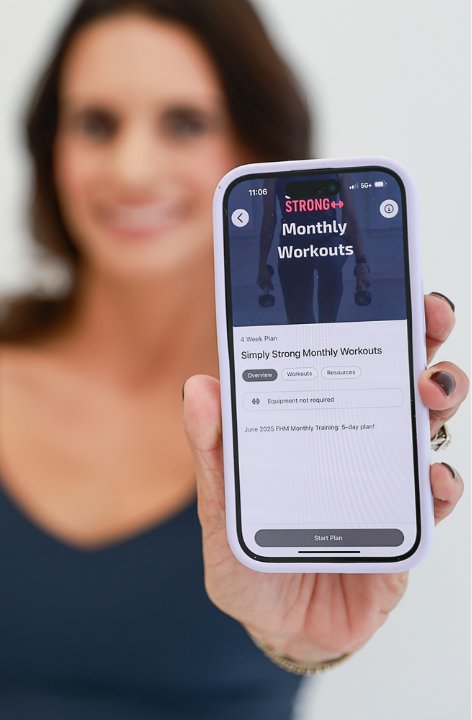
This is exactly what we do inside the Simply Strong App. I program monthly structured workout programs that focus on strength training fundamentals, progressive overload, and realistic training schedules. Take my quick quiz to see if you’re ready and get a coupon for 50% off your first month in the Simply Strong App.
FAQs
What is the best workout split for women to build muscle?
For many women, a 3 or 4-day split works really well. A 3-day full-body split spread across the week provides regular training opportunities, while a four-day upper/lower split allows you to distribute exercises across more sessions. The best option depends on your schedule, training experience, goals, and recovery.
Can women build muscle with dumbbells at home?
Absolutely! Dumbbells provide plenty of resistance to build muscle, especially when you’re following a structured program and the workouts are challenging your muscles while encouraging you to make progress as you get stronger.
How many reps should women do to build muscle?
I recommend women start with 8-12 reps for common strength training exercises, but muscle growth is possible across a wider range of reps. The most important component is choosing a resistance that makes the set challenging while allowing you to maintain good form and technique.
Can you build muscle and lose fat at the same time?
Yes, especially if you are new to strength training or new to progressive overload training. With consistent resistance training, aligned nutrition, and ample recovery, you can absolutely lose body fat and gain muscle at the same time. However, the rate of muscle growth and fat loss will depend on your starting point, nutrition habits, training, and a few other individual factors.
Do women over 40 need a different muscle-building workout plan?
No, not necessarily. The same basic training principles apply to women of all ages. Your exercise selection, training volume, weights, and recovery may need to be adjusted to your experience, health, and schedule, but turning 40 doesn't mean you need to stop challenging yourself or follow an entirely different set of training rules.
How long should a muscle-building workout last?
Many women are surprised to discover that they can accomplish a lot in just 30-45 minutes per day with strategic dumbbell workouts from home. This is exactly what we do in the Simply Strong App.